Youth work is an interesting profession. The vast majority of staff are under the age of 35. The average youth worker has worked in the sector for five years or less and it is as rare as hens teeth to find youth workers into their 50’s. Many years ago I heard a long term youth minister speak about the importance of having an age diverse youth workforce. Tim Hawkins, is that youth minister and as someone who has been in the gig for thirty odd years I think he is on to something.
We need workers who have experience and longevity in the field. We need some older workers with a lot of life in their years to strengthen the sector. We need the wisdom of experience.
Aaron Garth is a Melbourne-based youth worker, social worker, and mental health practitioner with over two decades of experience supporting young people across Australia. As Chief Executive Officer of Ultimate Youth Worker, he leads a team dedicated to training, coaching, and developing professionals in the youth sector.
A graduate of RMIT University and current PhD candidate, Aaron has worked across some of the most challenging areas of youth services — from homelessness and mental health to drug and alcohol outreach and residential care. He is a sought-after speaker, educator, and advocate for a more professionalised youth workforce, and has taught at institutions including RMIT, Chisholm Institute, and Eastern College Australia.
Aaron's work is driven by a simple belief: when youth workers are better supported, young people get better outcomes.
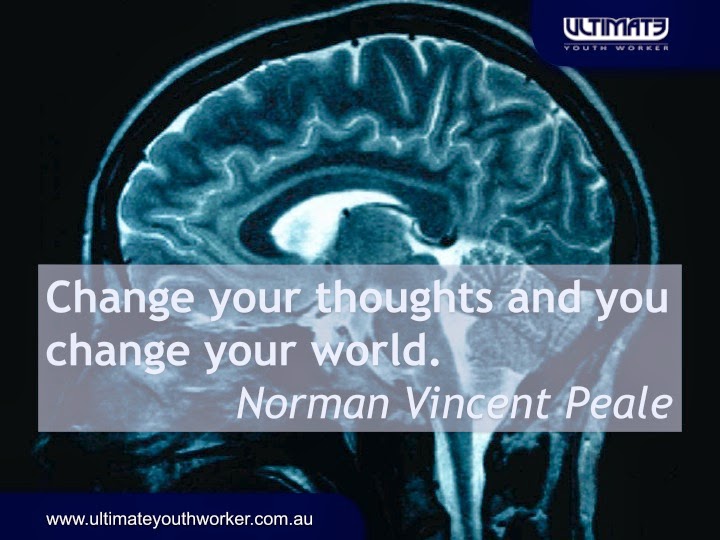
Perception. It is what causes many of the issues I see every day. It is also something that I have been thinking about a lot lately. Whether it is our perception of our clients, others perceptions of us or our perception of ourselves; how we think about the world informs our actions within it.
In the therapeutic world this is something that has taken hold through therapies such as CBT and REBT which ask us to change our way of thinking about issues and situations. The paradigm of positive psychology echoes this also. How we look at our situation denotes how we will stand up to the issues we are facing.
Our world is hurting. It seems like every time I turn on the news some new atrocity has happened. People are being killed, raped, cheated and broken by their fellow man. When working with our young people we hear the stories of brokenness that encompass their lives. It would be easy to se the world as beyond hope.
For us to show the hope that the world needs we must first change how we think about it. May of those who know me best believe that I am an eternal optimist. When it looks like its at its worst I see hope. When I hear of people turning against each other I look to peace. When I see people hurting I look to restoration. This does not mean that I am blind to the current situation, on the contrary I am acutely aware. It meant that I am looking to the future and to hope.
I was not always like this however. When I was a teen myself I was a glass is half empty kind of guy. The world was against me and no one could tell me differently. I always saw the worst in a situation and in others and I suffered for it. We ask our young people to change their way of thinking every day. Perhaps for us as a profession to go to the next level we must change our thoughts as well. If we do we can change the world.
Aaron Garth is a Melbourne-based youth worker, social worker, and mental health practitioner with over two decades of experience supporting young people across Australia. As Chief Executive Officer of Ultimate Youth Worker, he leads a team dedicated to training, coaching, and developing professionals in the youth sector.
A graduate of RMIT University and current PhD candidate, Aaron has worked across some of the most challenging areas of youth services — from homelessness and mental health to drug and alcohol outreach and residential care. He is a sought-after speaker, educator, and advocate for a more professionalised youth workforce, and has taught at institutions including RMIT, Chisholm Institute, and Eastern College Australia.
Aaron's work is driven by a simple belief: when youth workers are better supported, young people get better outcomes.
In a funding coup which has not hit the youth sector like this before three national governments have combined to cut youth work funding programs across the board. In what has been seen by some in the sector as governments colluding in a neoliberal sting projects including education, homelessness and mental health are being hit In Australia, Canada and the United Kingdom by significant funding cuts.
In Australia the Abbott government today announced that all federal government funding for youth projects would end by June 2014. The hardest hit by this is the Australian Youth Affairs Council which has yet to receive any funding to continue as the national peak youth work body. Other programs which may be effected by this issue include Education, Employment and Training; Drug and Alcohol services, Mental Health service provision and camp programs.
In Canada the Harper Government is currently looking to scrap funding across the Child and Youth Work sector. First cuts are to university programs Including all major CYW programs and many Social work programs. They have also hinted to further cuts to social service education programs. Funding cuts to remote and rural youth services, fly-in fly-out services and out of school hours programs have all been reported to be on the cards.
In the United Kingdom extreme funding cuts to child protection by the Cameron government come on the back of decreased funding to youth centres and youth justice programs. Further cuts to outreach programs and youth homelessness projects have been tabled in parliament and are expected to take force by end of May.
The saving grace to youth work in the developed world funnily enough comes from the United states where a massive increase to funding of Out of School Hours care just passed congress. Also a new program of youth social entrepreneurial ventures is being rolled out across 17 states including New York and Ohio.
If any of these program areas or funding issues affect you contact your local youth funding agency and tell them that you read this article on April 1st. If you have read this far we would like to say with a full and happy heart ARPIL FOOLS!
Aaron Garth is a Melbourne-based youth worker, social worker, and mental health practitioner with over two decades of experience supporting young people across Australia. As Chief Executive Officer of Ultimate Youth Worker, he leads a team dedicated to training, coaching, and developing professionals in the youth sector.
A graduate of RMIT University and current PhD candidate, Aaron has worked across some of the most challenging areas of youth services — from homelessness and mental health to drug and alcohol outreach and residential care. He is a sought-after speaker, educator, and advocate for a more professionalised youth workforce, and has taught at institutions including RMIT, Chisholm Institute, and Eastern College Australia.
Aaron's work is driven by a simple belief: when youth workers are better supported, young people get better outcomes.
We know that a significant number of our readers are youth ministers who are seeking to develop a deeper understanding of young people and youth work. We commend this endeavour. One of the slurs thrown at youth ministry is that it is little more than games and coffees… We disagree wholeheartedly. Youth work in a church context has become more and more complex over the years. More youth ministry professionals have sought to bring the training of youth ministers in line with their secular counterparts injecting developmental and psychological understanding into the theological context.
Over the last couple of years we have had the opportunity to support a number of youth ministries to develop their youth work capacity. Particularly, we have been involved with a movement of the Church towards relational based work with young people. Our work has been to provide a sounding board for ideas and a check and balance process when implementing them. We have also had the privilege of training a number of chaplains in supporting young people, mandatory reporting, suicide intervention and emergency management. These chaplains now have more training than the teachers and principals they work with in adolescent welfare. Over all we have seen a marked increase in training and professional development for those in youth ministry roles towards a more traditional youth work focus.
One group we have been keeping a keen eye on is the team at Youth Vision Victoria &Tasmania. YV, as they are fondly known, have spent a lot of their time developing youth ministers within the Churches of Christ denomination. YV run training and internships, regular professional development breakfasts as well as a number of programs for young people. One other thing that is put out is their quarterly journal ‘Youth Vision Quarterly’.
YVQ February 2014
In the latest edition two articles in particular stood out to me. The first by Mark Conner looks at self care for youth ministers. It could have come straight out of one of our posts on self care with the model used looking very familiar. I was glad to see self care being championed as this is an area that we are really passionate about. The second article by Keith Farmer looks at some of the transitions happening in ministry in Australia. One area that Keith illuminated was that of deeper relational focus in the work. This is also a huge area for youth workers to grapple with.
If you are a youth minister or an interested youth worker I highly recommend the work of the YV crew. Check out there website at http://vic.youthvision.org.au
Aaron Garth is a Melbourne-based youth worker, social worker, and mental health practitioner with over two decades of experience supporting young people across Australia. As Chief Executive Officer of Ultimate Youth Worker, he leads a team dedicated to training, coaching, and developing professionals in the youth sector.
A graduate of RMIT University and current PhD candidate, Aaron has worked across some of the most challenging areas of youth services — from homelessness and mental health to drug and alcohol outreach and residential care. He is a sought-after speaker, educator, and advocate for a more professionalised youth workforce, and has taught at institutions including RMIT, Chisholm Institute, and Eastern College Australia.
Aaron's work is driven by a simple belief: when youth workers are better supported, young people get better outcomes.
I recently came across this great article from Community Care in the UK through a post by the amazing Teenage Whisperer, Sam Ross. Sam reminds us that good supervision and support to reflect on the work is of extreme importance… something that as a social work student and youth worker in Australia we seem to lack as well.
Aaron Garth is a Melbourne-based youth worker, social worker, and mental health practitioner with over two decades of experience supporting young people across Australia. As Chief Executive Officer of Ultimate Youth Worker, he leads a team dedicated to training, coaching, and developing professionals in the youth sector.
A graduate of RMIT University and current PhD candidate, Aaron has worked across some of the most challenging areas of youth services — from homelessness and mental health to drug and alcohol outreach and residential care. He is a sought-after speaker, educator, and advocate for a more professionalised youth workforce, and has taught at institutions including RMIT, Chisholm Institute, and Eastern College Australia.
Aaron's work is driven by a simple belief: when youth workers are better supported, young people get better outcomes.
I have been in a number of agencies throughout my youth services career and only one of them had a written down budget for youth work professional development. In this organisation I had one of the largest budgets for professional development I had ever had… $1000. However in most organisations I worked in a professional development budget was at best ad hoc and at worse non-existent.
I have heard of a number of ways to divide up a professional development budget and to tell you the truth I have not put much credence in most of them. How long you have been in the organisation? Your role requirements? Your agencies needs? None of them make any sense when you are talking about longevity in the field. When you want to develop workers to sustain your organisation and the sector you have to think outside the box, and for most organisations that means spending money.
In the mining industry here in Australia some of the best mines realised that they were losing workers because they had no reason to stay. The money was good, The work wasn’t to hard but still they were losing staff… Until they started putting money in the right place. They set up great internet, provided training opportunities and expected staff to develop themselves through courses. Everything from first aid to business development. It was open to the newest of staff and the long tremors. From the lowest paid to the highest paid. The expectation was that you did something.
At Ultimate Youth Worker we would love to offer an unlimited budget for professional development but like every youth organisation we have to balance our budget too. In our case we devote 3% of our yearly budget for staffing to professional development. If you earn $50,000 you have a professional development budget of $1,500. We ask our staff to develop a professional development plan that has some things for us as an organisation and some areas that they want to work on. If they want to work on something that is outside the purview of the work we do we ask them to demonstrate how it would support the work we do in the future. If it would support us or the sectors development we are happy to provide the finances within the 3%. We also offer employees further development above the 3% as needed however as a minimum that 3% is always in our budget.
What does your organisation do? Perhaps you can start providing a guarantee for your employees!
Aaron Garth is a Melbourne-based youth worker, social worker, and mental health practitioner with over two decades of experience supporting young people across Australia. As Chief Executive Officer of Ultimate Youth Worker, he leads a team dedicated to training, coaching, and developing professionals in the youth sector.
A graduate of RMIT University and current PhD candidate, Aaron has worked across some of the most challenging areas of youth services — from homelessness and mental health to drug and alcohol outreach and residential care. He is a sought-after speaker, educator, and advocate for a more professionalised youth workforce, and has taught at institutions including RMIT, Chisholm Institute, and Eastern College Australia.
Aaron's work is driven by a simple belief: when youth workers are better supported, young people get better outcomes.
If I hear another person talk about the science behind youth work or the best-practice “research” that has been done I will scream. This pervasive discourse of youth work through a scientific lens, to the detriment of practice wisdom and individuality, will lead to the destruction of our sectors most central ideologies.
Putting people in comfortable boxes has never been central to the work of a youth worker, until recently. To have clear diagnoses, a cookie cutter support plan and a “best-practice” set of interventions is the way of the medical, psychological and scientific sectors. There has been a lot written about the divide between the art and science of youth work with much more over the past decade focusing on the scientific. This does not take into account the the complexities that coalface youth workers deal with on a daily basis. “Becoming a professional when one’s discipline is people/young people requires more than technical knowledge; it requires a way of being that is relational, emergent, flexible, dialogic, participatory, and contextualised“ (Fusco 2013).
Youth work is a flexible, fluid profession. We have historically steered clear of generalising how we work with individuals as it limits our fluidity. We seek to support young people in their context with their individual needs. When we begin to use the frameworks of economic rationalism and the sciences to frame our practice we begin to see people view our practice wisdom and philosophy as weak hokum. Where science seeks fact and answers to problems, we seek to delve into the human condition through questions and journeying with our young people.
There is no doubt that the scientific has bolstered youth work. What we know of brain and psychosocial development has become integrated into our practice kitbag. But, there is a big difference between using the knowledge of a profession and subscribing to its framework and philosophy. If we allow governmental managerialism and our own inadequacies to force us to give up what makes us unique we will regret it.
Aaron Garth is a Melbourne-based youth worker, social worker, and mental health practitioner with over two decades of experience supporting young people across Australia. As Chief Executive Officer of Ultimate Youth Worker, he leads a team dedicated to training, coaching, and developing professionals in the youth sector.
A graduate of RMIT University and current PhD candidate, Aaron has worked across some of the most challenging areas of youth services — from homelessness and mental health to drug and alcohol outreach and residential care. He is a sought-after speaker, educator, and advocate for a more professionalised youth workforce, and has taught at institutions including RMIT, Chisholm Institute, and Eastern College Australia.
Aaron's work is driven by a simple belief: when youth workers are better supported, young people get better outcomes.
Over the last couple of days I have been re-listening to some of my favourite podcasts from c2ypodcast. Two in particular grabbed my attention as the guests spoke about the failure of the professionalisation movement in light of youth work core principles. We have stated a number of times on this blog that the professionalisation debate is lacking and unhelpful at best. We believe that qualifications and metrics don’t make a professional… it takes passion, calling and a whole lot of work. First up was Professor Dana Fusco who in discussing her amazing work “Advancing Youth Work: Current Trends, Critical Questions” spoke of the threat that certification of youth workers holds for youth work. The research for other professions appears to show that certification and professionalisation of other professions has not led to the recognition which we as youth workers are seeking. Dana’s discussion led me to think that the striving to become more professional in the human services sector has led to a watering down of youth work principles and practice wisdom.
The second conversation was with an elder statesman in the field of youth work, Dr. Gerry Fewster. Gerry spoke of how insidious and easy it is for us to fall into the trap of practicing just like other human services professions such as psychology or social work in a world which waters down our practice as youth workers. That our uniqueness and ability to work with young people in a fluid way is compromised by blindly following into the mire of professionalisation.
Neither of these professionals believe that youth workers should be less than highly professional. What they do argue is that by limiting the scope and practice of youth workers through managerialism and metrics whilst seeking to gain a better reputation is ludicrous.
Lets be more professional every day, but let us never give up that which makes us unique.
Leave us a comment below or post a comment on Facebook and Twitter.
Aaron Garth is a Melbourne-based youth worker, social worker, and mental health practitioner with over two decades of experience supporting young people across Australia. As Chief Executive Officer of Ultimate Youth Worker, he leads a team dedicated to training, coaching, and developing professionals in the youth sector.
A graduate of RMIT University and current PhD candidate, Aaron has worked across some of the most challenging areas of youth services — from homelessness and mental health to drug and alcohol outreach and residential care. He is a sought-after speaker, educator, and advocate for a more professionalised youth workforce, and has taught at institutions including RMIT, Chisholm Institute, and Eastern College Australia.
Aaron's work is driven by a simple belief: when youth workers are better supported, young people get better outcomes.
Late last year Australian youth work was dealt a blow which hurt us to the core. Youth Studies Australia, our journal of 18 years, lost its funding and even after outcry from the sector and pledges to step in it closed up shop. As an avid reader for almost a decade I will miss the journal. The stories and articles as well as the reviews helped me in numerous ways though out my career. Youth Studies Australia is but one journal however that targets youth workers.
A cursory check of my old RMIT library account shows over 20 academic journals devoted to youth work from throughout the world. These journals cover the breadth and width of youth service provision and give youth workers varied policy and cultural backgrounds to draw from. Over the years I have read articles from all of these journals and have found them to provide great insight into young people and youth programs that youth workers can use to develop their own practice.
Previously on this blog we have implored youth workers to read a book, to develop their their knowledge and practice wisdom. We Have asked youth workers to seek professional development opportunities and to study harder. We have asked youth workers to be more accountable to the young people and the sector. One of the easiest and least time consuming ways we know of doing this is reading journal articles.
Journal articles are bite sized peer reviewed gold nuggets of practice wisdom which take less than half an hour to consume and which give years of excellent ideas. Articles are the way Ultimate Youth Workers share what is working for them and their young people for us to leverage in our own practice environment. It is also the most up to date research available to the sector.
In a nutshell, read up.
Leave us a comment below or post a comment on Facebook and Twitter.
Aaron Garth is a Melbourne-based youth worker, social worker, and mental health practitioner with over two decades of experience supporting young people across Australia. As Chief Executive Officer of Ultimate Youth Worker, he leads a team dedicated to training, coaching, and developing professionals in the youth sector.
A graduate of RMIT University and current PhD candidate, Aaron has worked across some of the most challenging areas of youth services — from homelessness and mental health to drug and alcohol outreach and residential care. He is a sought-after speaker, educator, and advocate for a more professionalised youth workforce, and has taught at institutions including RMIT, Chisholm Institute, and Eastern College Australia.
Aaron's work is driven by a simple belief: when youth workers are better supported, young people get better outcomes.
I have read more policy documents in the last month than I have read in the last two years. It has really hurt my head! Not because of the ammount of reading, but because of the lack of genuine content in the pages. A lot of the policy documents were very circular and led the readers round in circles. Others were full of legalise and bureaucratic jargon which really said nothing. I wish I could say that this was an unfortunate occurence which only happemned the once… but it is a trend I see every week.
Policy is useless if it is not easily readable and practically based. This is not an issue solely belonging to large government departments, it is an issue which we have seen in small, medium and large organisations from government, not-for-profit and corporate industry. People tend to make their policy very vague!
When a policy is vague the responsibility for action is also vague. You cannot go to you boss every five minutes because the policy is lacking. So what are we to do? Use our practice wisdom.
When the policy is lacking and your boss is vague your practice wisdom should kick in. A strong understanding of your sector and its ethics can guide you where your organisation fails to guide. Some argue that organisations are deliberately vague in policy to limit litigation and to place the focus on individual workers. If you can explain why you did wha you did and that it links with your industry code of ethics this also helps to limit your likelihood of litigation and also provides good practice to your clients.
If your policies are vague bring it up with your boss and human resources department as this will not help you in the long run. But when all is said and done policies cannot cover all aspects of the work we do as youth workers.
Aaron Garth is a Melbourne-based youth worker, social worker, and mental health practitioner with over two decades of experience supporting young people across Australia. As Chief Executive Officer of Ultimate Youth Worker, he leads a team dedicated to training, coaching, and developing professionals in the youth sector.
A graduate of RMIT University and current PhD candidate, Aaron has worked across some of the most challenging areas of youth services — from homelessness and mental health to drug and alcohol outreach and residential care. He is a sought-after speaker, educator, and advocate for a more professionalised youth workforce, and has taught at institutions including RMIT, Chisholm Institute, and Eastern College Australia.
Aaron's work is driven by a simple belief: when youth workers are better supported, young people get better outcomes.









 First up was