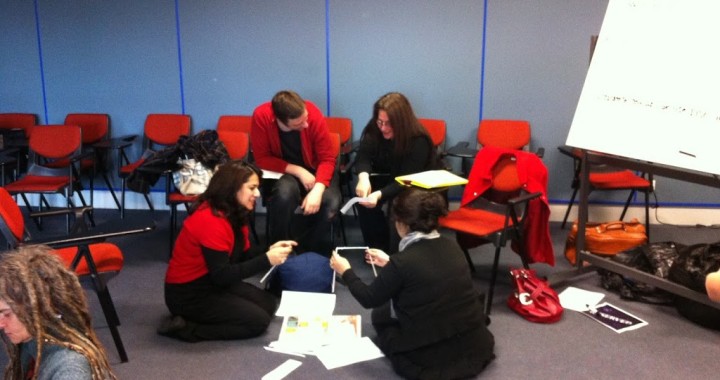
A short one today! Over the last couple of weeks I have been working with a number of student youth workers helping them with their field placements. One of the most frustrating things tat I have seen in these new recruits to the sector is something which has become more prevalent over the last decade. They don’t take notes!!!
It is really hard to take notes when you don’t have a pen and something to write on. Some say they can do it on their phone or Ipad, but the reality is that there is no substitute for pen and paper.
When I was a new member of the working class a mentor of mine said to me that I should take pen and paper into every meeting I ever have. Write everything down he told me. Your memory is not as good as you think it is he said. He was right!
The one piece of advice I give my students and many of those that we supervise is take a pen and paper every where. Write everything down. You never know what you will need to remember!
Aaron Garth is a Melbourne-based youth worker, social worker, and mental health practitioner with over two decades of experience supporting young people across Australia. As Chief Executive Officer of Ultimate Youth Worker, he leads a team dedicated to training, coaching, and developing professionals in the youth sector.
A graduate of RMIT University and current PhD candidate, Aaron has worked across some of the most challenging areas of youth services — from homelessness and mental health to drug and alcohol outreach and residential care. He is a sought-after speaker, educator, and advocate for a more professionalised youth workforce, and has taught at institutions including RMIT, Chisholm Institute, and Eastern College Australia.
Aaron's work is driven by a simple belief: when youth workers are better supported, young people get better outcomes.
A while ago we wrote on what post-qualifying education might look like for the youth sector. We had a number of people agree and disagree with our thoughts but the one thing that we kept coming back to was the current state of youth worker education. Our sticking point in these discussions was the lack of practical placement in current education.
In a recent survey of its members the Youth Workers Association in Victoria came to the belief that no more than 30% of a youth work course should be undertaken “on the job”. The reality of the average youth work degree is that it is more like 15%. The issue that we see is that youth worker education is becoming an almost purely theoretical endeavour. When the core of our work is developing relationships can this truly be taught through theory alone???
Recently I was chatting with a friend who is completing a degree in tourism and marketing and he was surprised to hear that we did not need to complete an industry year. In his course they complete two years of study, then an industry year, and return to complete their final year. This not only leads students to gain a practical understanding of their field, but also provides links to employment.
As a teacher in the field education of youth workers and a former employer I have noticed a severe lack of industry knowledge and practical skills in students and graduates of youth work courses. In our attempt to make youth work a theoretically sound profession we are losing much of the practice skill development. We are turning out a great number of theoretical practitioners but rare is the great practitioner.
We don’t need less practical placement in youth work education, we need more! You can’t learn youth work from a book…it must be learnt through doing it. Sixty-five days of placement in a couple of youth services is not nearly enough for students to gain a depth of understanding in youth work practice. We believe that the model of an industry year is a good starting point however to make it a worthwhile learning experience there must be opportunities to critically reflect for both student and organisation. Mentoring of new students is a possible answer to this conundrum. Perhaps universities could provide regular seminars on new research as a link between industry and academia.
The point is students need to have a stronger link to industry before they graduate.
Aaron Garth is a Melbourne-based youth worker, social worker, and mental health practitioner with over two decades of experience supporting young people across Australia. As Chief Executive Officer of Ultimate Youth Worker, he leads a team dedicated to training, coaching, and developing professionals in the youth sector.
A graduate of RMIT University and current PhD candidate, Aaron has worked across some of the most challenging areas of youth services — from homelessness and mental health to drug and alcohol outreach and residential care. He is a sought-after speaker, educator, and advocate for a more professionalised youth workforce, and has taught at institutions including RMIT, Chisholm Institute, and Eastern College Australia.
Aaron's work is driven by a simple belief: when youth workers are better supported, young people get better outcomes.
We are finally here our series on mental state exams is in its last week. Over the past eight weeks we have built an understanding of the core components of a mental state exam so that we can support our young people as best we can. This week I was speaking with a youth worker in one of Victoria’s largest Christian denominations about a mental health conference he was at. I was reminded about how important it is for all youth workers to have a strong understanding of mental health. So far we have discussed how a young persons appearance,behaviour,speech and language, mood and affect, thought process and content, their perceptions and how their cognition can provide indicators as to their mental state. Today we discuss how a young persons insight and judgement can provide insight into their current mental health status.
Insight
A young persons insight into their own mental health and possible treatment options is key to the extent to which effective support can be provided. The young persons understanding of his or her mental illness is evaluated by exploring their explanation of the problem, and their understanding of the potential treatment options. The three main areas in which we need to be aware when assessing a young persons insight: recognition that they have a mental health issue, compliance with a treatment plan, and the ability to describe unusual mental events (such as delusions and hallucinations) as abnormal.
Insight is assessed on a continuum and therefore youth workers should not describe it as simply present or absent, but should descriptively assess the young persons ability. Impaired insight is characteristic of disorders such as psychosis and dementia, and is an important consideration in the development of treatment plans and in assessing the capacity of a young person to consent to treatment.
Mental health issues have become more frequently reported and diagnosed however the ability for many people including young people to accept that they have a mental health issue is still a concern. Insight is linked closely to cultural, religious and societal norms and these things should be considered while supporting a young person.
Judgment
When we are observing judgment it refers to the young persons ability to make reasonable, sound and responsible decisions. Contemporary use of this in a mental state exam asks us to inquire about how the young person has responded or would respond to real-life challenges and contingencies; for example, ‘What would you do if your mother stated that she thought you were depressed?‘. In this form of questioning we are looking to see if the young person is able to respond in a way that shows insight into their situation and possible next steps.
Assessment of the young persons judgement would include amongst other areas the individual’s executive capacity in terms of impulsiveness, social cognition, self-awareness and planning ability. If the young person appears to be providing abnormal judgement it is not necessarily a link to a mental health issue as it is not part of any diagnosis. However, if there is an impairment in judgement it may be an issue of safety for the person and the community.
———————————————————————-
Mental state exams are a skill that needs to be practiced and refined. The basic ideas that we have discussed over the past eight weeks are just that the basics. These tools will not make you a psychiatrist!!! If you believe that a young person is having some mental health struggles then you can use these tools to support your case.
Aaron Garth is a Melbourne-based youth worker, social worker, and mental health practitioner with over two decades of experience supporting young people across Australia. As Chief Executive Officer of Ultimate Youth Worker, he leads a team dedicated to training, coaching, and developing professionals in the youth sector.
A graduate of RMIT University and current PhD candidate, Aaron has worked across some of the most challenging areas of youth services — from homelessness and mental health to drug and alcohol outreach and residential care. He is a sought-after speaker, educator, and advocate for a more professionalised youth workforce, and has taught at institutions including RMIT, Chisholm Institute, and Eastern College Australia.
Aaron's work is driven by a simple belief: when youth workers are better supported, young people get better outcomes.
One of the first options put forward to my youth work class for gainful employment was working in the youth justice system. I looked into it with keen enthusiasm as it was one of the areas I was interested in when I first joined the course. I began looking at the policies and practice standards required of the sector and was excited to see the focus on restorative practices. I read some journal articles and blog posts and began to ask some questions. Finally, I asked a few people who worked in the sector what it was really like and my whole worldview was thrown into a spin.
Many of the youth workers I spoke to felt like little more than jailers or parole officers. They felt that their role was to keep the young people from causing trouble to society. They mentioned that they got to use some youth work skills however it was minimal. The focus of their work seemed to me to be clearly in the ballpark of retribution not restoration.
I was downtrodden. The system seemed to be talking the talk but not walking the walk. I was put in contact with a number non government support agencies to see what else was happening and my view became brighter. Group conferencing, crime prevention, family mediation and mentoring became my landscape of hope. Perhaps the youth justice system wasn’t so bad.
A number of the youth workers that I met in the statutory youth justice system were what I now know as canny outlaws. Rallying against the system these youth workers spend time building relationships, helping to keep young people involved in treatment programs and providing much needed guidance. The main thing is that these youth workers practiced youth work.
If you are a youth worker in a youth justice system, you need to remember that your first duty is to the young people. You are not a police officer, parole officer or jailer. You are a youth worker. If you remember that then you will provide justice to these most troubled of young people.
Leave us a comment below or post a comment about this post on facebook and twitter.
Aaron Garth is a Melbourne-based youth worker, social worker, and mental health practitioner with over two decades of experience supporting young people across Australia. As Chief Executive Officer of Ultimate Youth Worker, he leads a team dedicated to training, coaching, and developing professionals in the youth sector.
A graduate of RMIT University and current PhD candidate, Aaron has worked across some of the most challenging areas of youth services — from homelessness and mental health to drug and alcohol outreach and residential care. He is a sought-after speaker, educator, and advocate for a more professionalised youth workforce, and has taught at institutions including RMIT, Chisholm Institute, and Eastern College Australia.
Aaron's work is driven by a simple belief: when youth workers are better supported, young people get better outcomes.
Over the years I have had the pleasure of working with a number of young people who have had run ins with the justice system. Many of these young people have had people look down on them because of their infringements. A number of them have since become youth workers.
Over the last couple of years we have had a number of inquires and inquests into the abuse of young people in care in Victoria. It never fails that there was a lapse in organisational protocols that let someone with a record into a place of trust who then abused their role. However, for every one person who causes trouble hundreds more go about their job with honour. The issue however is that the public view and society more broadly is that if you have a police record you are not worthy of being placed in a position of trust. We are a species which seeks retribution rather than restoration.
This of course leads to issues in youth services as we believe strongly in the restoration of people, the focus on strengths and the ability for people to choose their own destiny. It is also an issue as many youth workers come from having been troubled youth themselves! I think we would be surprised to see how many youth workers had some sort of record.
To attempt to negate the negative we have instituted a number of safeguards including a Working With Children Check and Police Check to screen potential youth workers for their appropriateness. However, if you went by the general recommendation a person with a record would still not be able to get a position, whether your offence was superficial or serious. As an employer I have employed youth workers with and without police records. The seriousness of their offence is always one of my first questions but if it is a minor offence I am know to have a discussion.
I remember sitting in a court room when a Judge told a young man who was about to start a youth work course that he was an idiot for his infringements. The Judge told the young man that with his background and his knowledge of the justice system he would make a great youth worker. That was over a decade ago and I have had to deal with the fallout of a stupid decision ever since. Many youth workers are in the game to help young people stay on the straight and narrow and hopefully not head down the path that they trod.
Youth workers need passion and conviction. A conviction against their name is not necessarily a reason to exclude someone from becoming a youth worker. As with most things that develop an Ultimate Youth Worker its all about character. Whether you have a record or not I will not employ a youth worker if they can’t show character. If you have a police record let people know, show them your character. If you are hiring and a person states that they have a record have a discussion, see if their character is a fit for your organisation. Above all be transparent.
Aaron Garth is a Melbourne-based youth worker, social worker, and mental health practitioner with over two decades of experience supporting young people across Australia. As Chief Executive Officer of Ultimate Youth Worker, he leads a team dedicated to training, coaching, and developing professionals in the youth sector.
A graduate of RMIT University and current PhD candidate, Aaron has worked across some of the most challenging areas of youth services — from homelessness and mental health to drug and alcohol outreach and residential care. He is a sought-after speaker, educator, and advocate for a more professionalised youth workforce, and has taught at institutions including RMIT, Chisholm Institute, and Eastern College Australia.
Aaron's work is driven by a simple belief: when youth workers are better supported, young people get better outcomes.
I was having a conversation with a diploma student today that made the hair on the back of my kneck stand on edge. He said to me without a hint of a joke that once he had finished his two year course that he would be qualified enough to become a manager in the organisation that he volunteers in. I remember having a conversation with a couple of my mates as we were coming to the end of our degree and a number of them believed that they had reached the pinnacle of youth service leadership. In Victoria the Youth Workers Association and many of the proponents of professionalisation have placed an inordinate amount of weight on qualifications and their ability to measure leadership in the sector.
Don’t get me wrong, I think that a three year degree does give you some bragging rights over someone who has only done a year… but it doesn’t necessarily mean you are a leader in the sector. Victoria’s Commissioner for Children and Young People, one of the leaders of the sector, attained no formal qualification but holds an honorary degree in youth work. Many of the best youth workers I know have minimal formal youth work qualifications. Qualifications do not make you a leader.
Youth workers are looking for leaders in the field.
There is no denying that the youth sector is in need of strong leaders to guide it into the future. What would this leadership look like??? Here are a few thoughts:
Focused on effective results not efficient KPI’s.
Advocates for sector wide reforms including; better funding, focus on holistic interventions and staff support.
Developers of new research and practice literature which brings a youth work specific body of work to academia.
A core focus on our clients need, not our funding bodies “requirements”.
The ability to inspire the next generation of youth workers to expand the profession.
The wisdom to change with the times and not follow blindly other human service professions
A focus on character rather than qualifications when recruiting new staff.
A recognition of the role of youth workers by broader society
Not one of these rely on a person holding a qualification. What would you add to the list?
Leave us a comment below or post a comment on facebook and twitter.
Aaron Garth is a Melbourne-based youth worker, social worker, and mental health practitioner with over two decades of experience supporting young people across Australia. As Chief Executive Officer of Ultimate Youth Worker, he leads a team dedicated to training, coaching, and developing professionals in the youth sector.
A graduate of RMIT University and current PhD candidate, Aaron has worked across some of the most challenging areas of youth services — from homelessness and mental health to drug and alcohol outreach and residential care. He is a sought-after speaker, educator, and advocate for a more professionalised youth workforce, and has taught at institutions including RMIT, Chisholm Institute, and Eastern College Australia.
Aaron's work is driven by a simple belief: when youth workers are better supported, young people get better outcomes.
Youth work is a difficult profession. It requires the patience of a saint, the wisdom of Aristotle and the stamina of a thoroughbred. In the craziness of all we do sometimes excellence is traded for efficiency. How many of us have been asked to cut corners to meet our funding targets or have been required to work with more clients to meet deadlines??? Often when our efficiency increases our effectiveness suffers.
Ultimate youth worker’s recognise that efficiency is not the be all and end all. We seek to find the best opportunities to meet the needs of our clients time and time again… and for the most part these opportunities are different for each client. The idea of best practice meaning one single fixed form of doing something is foreign to the youth worker. However, being there through thick and thin, when others leave and our young people see no hope that is the mark of an Ultimate Youth Worker.
Reflective practice is a skill that takes practice
“We are what we repeatedly do. Excellence, therefore, is not an act but a habit“. Aristotle
The best youth workers I know are those who spend their time repeatedly doing the work of a youth worker. They run groups, case manage, play games, build relationships, advocate and plan programs to name but a few tasks. They do this over and over again until it seems like second nature and then they do it some more. When they are asked to do something outside their purview they become canny outlaws and work for the best of their client without dropping effectiveness.
In his ground breaking book Outliers, Malcolm Gladwell states that it takes a minimum of 10,000 hours to become truly successful at a task. This means that the average full time youth worker would need to work for just over five years to become successful, or upwards of ten years for a part timer. If we as a field expect excellence of our youth work colleagues we must first understand that it takes time and energy (at least five years) to learn how to do the job. If the anecdotal evidence is anything to go by then the average of a two year career expectancy for youth workers leaves them startlingly short. We need to invest more time in new youth workers in the first five years of their career to help them achieve excellence.
Aaron Garth is a Melbourne-based youth worker, social worker, and mental health practitioner with over two decades of experience supporting young people across Australia. As Chief Executive Officer of Ultimate Youth Worker, he leads a team dedicated to training, coaching, and developing professionals in the youth sector.
A graduate of RMIT University and current PhD candidate, Aaron has worked across some of the most challenging areas of youth services — from homelessness and mental health to drug and alcohol outreach and residential care. He is a sought-after speaker, educator, and advocate for a more professionalised youth workforce, and has taught at institutions including RMIT, Chisholm Institute, and Eastern College Australia.
Aaron's work is driven by a simple belief: when youth workers are better supported, young people get better outcomes.
Second last post this week for our series on Mental State Exams. Over the past few weeks we have been building an understanding of the core components of a mental state exam so that we can support our young people as best we can. This week I was speaking with a youth worker in one of Victoria’s largest Christian denominations about a mental health conference he was at. I was reminded about how important it is for all youth workers to have a strong understanding of mental health. So far we have discussed how a young persons appearance,behaviour,speech and language, mood and affect, thought process and content and their perceptions can provide indicators as to their mental state. Today we discuss how a young persons cognition can provide insight into their current mental health status.
In this section of the Mental State Exam we are looking at a young person’s level of alertness, orientation, attention, memory and executive functions. It is often this part of the MSE which requires the use of structured tests in conjunction to unstructured observation. However, an astute youth worker can use the basic understanding learnt here to gain a base level to work from. Cognition is observed through judging alertness, orientation, attention and concentration, memory and executive functioning.
When observing alertness we are looking into the young person’s level of consciousness i.e. awareness of, and responsiveness to their environment. Their level of alertness may be described as alert, vigilant, clouded, drowsy, or stuporous. If you are on a camp or at the end of a long Friday night youth group then alertness may be low. Conversely, on your way to a concert or game of laser tag alertness may be quite high. There are many factors which you must take into account when observing alertness. Rock, paper, scissors is a great game for testing the alertness of a young person.
Orientation is assessed by asking the young person their name, age etc (orientation to person) where he or she is (for example what building, town and state) and what time it is (time, day, date). What we are looking for is that they are oriented in person, place and time. People who have taken a big knock on the football field and are dazed are often asked these questions to observe whether they have a concussion. In the drug and alcohol field we often use these questions when people seem substance affected to judge how affected they are.
Attention and concentration are assessed by using structured tests such as series seven tests, or if you are in a pinch getting them to spell a five-letter word backwards), and by testing digit span. Here we are looking to see if the young person can keep their focus and concentration whilst completing given tasks. These tests are great for judging inebriation, attention deficits and anxiety.
Memory is assessed in terms of immediate registration (repeating a set of words), short-term memory (recalling the set of words after an interval, or recalling a short paragraph), and long-term memory (recollection of well known historical or geographical facts). If there is a severe issue with memory it may indicate dementia or neurological issues. Short term memory loss can be a symptom of anxiety.
Executive functioning can be screened for by asking the “similarities” questions (“what do x and y have in common?”) and by means of a verbal fluency task (e.g. “list as many words as you can starting with the letter F, in one minute”). The mini-mental state examination is a simple structured cognitive assessment which is in widespread use as a component of the MSE. These tests are looking at higher order brain functioning and a persons ability to stay on task. This is important for their ability to think in a critical way.
Note: The kind of brief cognitive testing discussed here are regarded as a screening process only, and any abnormalities should be more carefully assessed using formal neuropsychological testing.
Stay tuned for our final segment next week: Insight and Judgement.
Aaron Garth is a Melbourne-based youth worker, social worker, and mental health practitioner with over two decades of experience supporting young people across Australia. As Chief Executive Officer of Ultimate Youth Worker, he leads a team dedicated to training, coaching, and developing professionals in the youth sector.
A graduate of RMIT University and current PhD candidate, Aaron has worked across some of the most challenging areas of youth services — from homelessness and mental health to drug and alcohol outreach and residential care. He is a sought-after speaker, educator, and advocate for a more professionalised youth workforce, and has taught at institutions including RMIT, Chisholm Institute, and Eastern College Australia.
Aaron's work is driven by a simple belief: when youth workers are better supported, young people get better outcomes.
Over the last few months we have been working with a number of organisations to help them develop in one way or another. For some it is providing supervision, for others it is developing policies and procedures and others it is a top down organisational overhaul. In almost all of these organisations we have noticed that youth workers are really good at throwing each other under the bus! We are even better than our clients!
The amount of cat fights and general mistrust that we have witnessed is truly astonishing. Colleagues who would turn against each other over trivial issues and games of oneupmanship that would put most two year olds to shame. I must say it made me sick to think that I belonged to such a profession. It has led me to ask the question “Why do youth worker’s struggle to work together???“
Here are my current thoughts:
Youth work has become a competitive industry and this permeates through to staff.
Vicarious trauma which is not dealt with properly has to come out eventually, usually in burnout.
When people work in close proximity in tough situations it can lead to some personality clashes.
Managers provide minimal accountability and do not squash issues within the team quickly enough.
Some people are just not cut out for youth work!!!
What do you think??? Leave us a comment below or post a comment on facebook and twitter.
Aaron Garth is a Melbourne-based youth worker, social worker, and mental health practitioner with over two decades of experience supporting young people across Australia. As Chief Executive Officer of Ultimate Youth Worker, he leads a team dedicated to training, coaching, and developing professionals in the youth sector.
A graduate of RMIT University and current PhD candidate, Aaron has worked across some of the most challenging areas of youth services — from homelessness and mental health to drug and alcohol outreach and residential care. He is a sought-after speaker, educator, and advocate for a more professionalised youth workforce, and has taught at institutions including RMIT, Chisholm Institute, and Eastern College Australia.
Aaron's work is driven by a simple belief: when youth workers are better supported, young people get better outcomes.
In our work the staff at Ultimate Youth Worker meet with a number of downtrodden, stressed out youth workers who are just trying to keep it together. Why these fine examples of the social services sector have begun to erode is anyone’s guess. Overworked, under payed, vicarious trauma, limiting government policies and organisations that don’t care are all excuses we hear for burnout and workplacestress. But you know what we all face that, so why do so many fade away???
Youth work isn’t always fun!
The one thing that we see over and again that separates those who can push through stress and those who get squashed under the pressure is purpose. When the youth worker’s who are close to the edge are asked why they got into youth work it invariably is for a nothing reason. “I wanted to become a teacher and I though this would help“. “I just felt like these kids need help“. “People just need to give something back“. The worst offenders are those with altruistic motives.
“A difficult time can be more readily endured if we retain the conviction that our existence holds a purpose – a cause to pursue, a person to love, a goal to achieve.”- John Maxwell
Unless you have the courage of your convictions youth work will chew you up and spit you out. Youth work is a purpose that you need conviction to follow. A reason to wake up in the morning. A cause to pursue. A goal to achieve. Youth work is more than a stepping stone to your next career. Youth work is not something you do to warm the cockles of your heart. Youth work is a profession that needs professionals with the right reason for being there… A real purpose.
What gets you out of bed in the morning???? Is your purpose to support young people to become the best they can possibly be? Or perhaps you are in it for the inordinately large pay check! If your own values and purpose aren’t clear then you are on a fast track to burnout.
Aaron Garth is a Melbourne-based youth worker, social worker, and mental health practitioner with over two decades of experience supporting young people across Australia. As Chief Executive Officer of Ultimate Youth Worker, he leads a team dedicated to training, coaching, and developing professionals in the youth sector.
A graduate of RMIT University and current PhD candidate, Aaron has worked across some of the most challenging areas of youth services — from homelessness and mental health to drug and alcohol outreach and residential care. He is a sought-after speaker, educator, and advocate for a more professionalised youth workforce, and has taught at institutions including RMIT, Chisholm Institute, and Eastern College Australia.
Aaron's work is driven by a simple belief: when youth workers are better supported, young people get better outcomes.