Article: Toward a youth work profession

Article Review: Michael Emslie’s “Toward a Youth Work Profession”

For decades, youth workers across Australia and beyond have asked an important question: Is youth work a profession? In his seminal 2013 article, “Toward a Youth Work Profession”, academic and practitioner Michael Emslie argues that the answer is yes—if we’re willing to do the work from within the sector. Emslie explores the idea that professionalization is not just a structural or economic change, but a cultural and philosophical one. He believes that unless youth workers define their own practice, we risk being shaped by bureaucratic systems that don’t reflect our values. At Ultimate Youth Worker, this message lands powerfully, because we believe youth work should always be principled, passionate, and professional—on our own terms.

Emslie identifies a persistent theme in the sector: youth workers want legitimacy, respect, and recognition, but often lack the structures to achieve them. He explains that youth work remains one of the only helping professions without clearly defined standards, national registration, or strong representation. According to Emslie, this weakens our ability to advocate for better pay, working conditions, and influence in multidisciplinary settings. Yet the desire for professionalization remains strong, precisely because it promises these improvements while also strengthening our occupational identity. His point is clear: if we want to secure our future, we must build it ourselves.

Drawing on the sociology of professions, Emslie contrasts two paths to professionalization: one from within the sector (led by practitioners), and one from above (led by governments or employers). The former empowers youth workers to define their own ethical standards, practice frameworks, and priorities. The latter risks co-opting youth work for managerial purposes, such as cost-efficiency and risk management. Emslie warns that if youth workers do not take the lead, others will do it for us—and not necessarily in ways that benefit young people or reflect our unique practice. At Ultimate Youth Worker, we echo this concern: we’ve seen what happens when practice is dictated by compliance, not compassion.

Emslie supports his argument with international examples, showing how other countries have progressed the professionalization agenda. He highlights the UK’s development of national occupational standards and an institute for youth work, and Canada’s comprehensive system of provincial youth care associations. He also notes efforts in Europe, New Zealand, and the United States to create ethical codes, credentialing systems, and national conferences. These examples provide both inspiration and a challenge: if others have managed to professionalize youth work, why hasn’t Australia? For us, these stories are fuel—we see what’s possible when youth workers unite and push for sector-wide reform.

The article doesn’t just describe what has happened; it offers practical strategies for change. Emslie proposes forming national associations, developing ethical codes, and building clear career pathways. He emphasizes that these structures must be designed by youth workers, not imposed by external bureaucracies. At the same time, he acknowledges the importance of collaboration with other stakeholders—such as unions, universities, peak bodies, and governments—to gain legitimacy and funding. This balanced approach is realistic and strategic, showing that we can lead without isolating ourselves from the broader system.

A key part of Emslie’s argument is that professionalization should serve young people, not just workers. He challenges us to articulate what good youth work looks like, and to build standards that support that vision. This means defining our values, identifying what knowledge youth workers need, and supporting continuous professional development. Emslie believes that doing this will not only protect the profession from erosion, but also improve outcomes for the young people we serve. At Ultimate Youth Worker, this is the heart of our work—we believe professionalism should always be about creating better, more ethical, and more effective support for young people.

Of course, Emslie is not naïve about the obstacles. He acknowledges that some in the sector fear professionalization will become elitist or bureaucratic. Others worry that it will exclude passionate workers without formal qualifications, or stifle creativity and innovation. But Emslie argues that professionalization, when led by practitioners, can protect diversity and innovation—not diminish it. Rather than gatekeeping, it can create shared values, promote ethical practice, and support quality care across the board.

Emslie also tackles the economic reality: yes, professionalization can come with costs, such as fees for training or association membership. But not professionalizing has a cost too—one paid in poor wages, job insecurity, and lack of voice in policy spaces. Youth work continues to lag behind other professions like teaching and nursing, not because the work is less important, but because we haven’t yet built the structures to advocate for ourselves. Emslie reminds us that if we want better conditions, we need a united and professional voice to demand them. This is why we’ve built our supervision and training programs at Ultimate Youth Worker—to equip the field for that next step.

Another concern Emslie addresses is the fear that regulating youth work could reduce its radical or “edgy” character. He counters this by referencing philosopher Alasdair MacIntyre, who argues that the integrity of a practice is protected, not diminished, by virtuous institutional structures. Good professionalization doesn’t flatten the uniqueness of youth work—it celebrates it and protects it. The challenge is to define what good youth work really is, and then build structures that uphold it. This is a challenge we are ready to take on, and we believe many in the sector are too.

In his conclusion, Emslie lays out a roadmap for action. He urges youth workers to build coalitions, create professional associations, and develop ethical codes and credentialing processes. He suggests working within existing structures (like Professions Australia or AHPRA) or, if needed, creating our own. Importantly, he advocates for establishing an international youth work federation, much like the International Federation of Social Workers, to unite practitioners across the globe. These are bold ideas, but they are grounded in realism and informed by global practice.

Ultimately, “Toward a Youth Work Profession” is more than a theoretical piece—it’s a strategic call to action. It challenges youth workers to step up and claim our profession, while also providing a clear, practical guide for how to do so. For us at Ultimate Youth Worker, it reaffirms our mission: to support the development of a youth sector that is deeply principled, genuinely passionate, and uncompromisingly professional. If we want to build a future where youth work is respected, resourced, and resilient, then professionalization isn’t optional—it’s essential.

Mic Emslie

Michael Emslie is a lecturer in the Youth Work and Youth Studies degree in the Social Work and Human Services discipline in the School of Global, Urban and Social Studies at RMIT University.

Michael’s extensive education, work experience and research demonstrates a long held passion and deep commitment to explore, pursue and promote good practice in human service and in particular youth work. Michael is particularly interested in questions concerning how practice is thought about, known, done, and supported in these fields. 

Aaron Garth

Aaron Garth

Aaron Garth is the Executive Director of Ultimate Youth Worker. Aaron has worked as a youth worker in a number of settings including local church, street drug and alcohol outreach, family services, residential care, local government and youth homelessness since 2003. Aaron is a regular speaker at camps, retreats, & youth work training events and is a dedicated to seeing a more professional youth sector in Australia. Aaron is a graduate of RMIT University and an alumnus of their youth work program. He lives in Melbourne with his wife Jennifer & their daughters Hope, Zoe, Esther, Niamh and son Ezra.

More Posts - Website

Follow Me:Add me on XAdd me on FacebookAdd me on LinkedInAdd me on PinterestAdd me on YouTube

Thinking Critically About Youth Work

Podcast 043: Thinking Critically About Youth Work – Part 2

Thinking Critically About Youth Work

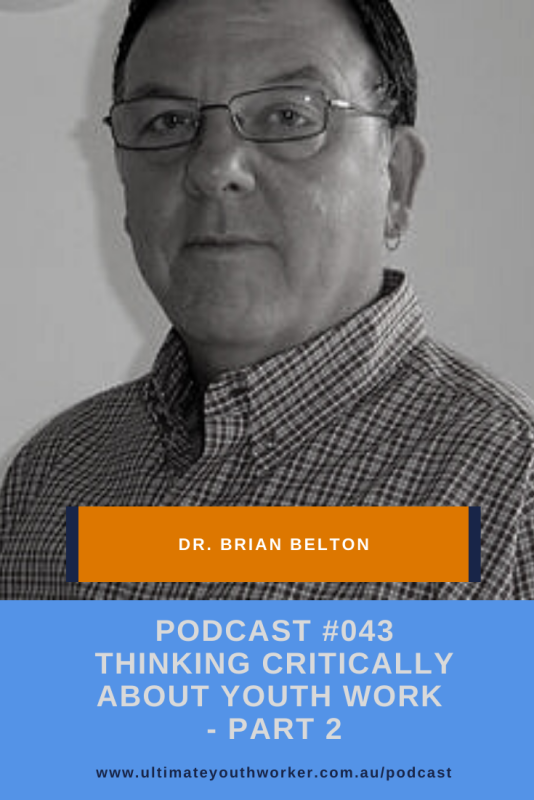
In todays episode of the Ultimate Youth Worker Podcast, “Thinking Critically About Youth Work: Part Two”, Aaron continues to speak with Dr. Brian Belton about the need for youth workers to be critically reflective about who we are as professionals.

Taking our conversation up to the next level we speak about the need for supervision to help youth workers become more critically reflective. We talk about why we need this for the benefit of the profession and for the young people we support.

Thinking Critically About Youth Work: Part 2

Dr. Brian Belton

Brian Belton (FB: @Dr. Brian Belton LI: @Brian Belton) is an international consultant and academic specialising in youth work, supervision and identity studies. Previously he was the Director of International Education, Research and Training at the YMCA George Williams College, London.

Coming from an East London/Gypsy family, Brian played a leading role in the youth gang life of that area in the late 1960s/early 1970s.  While attending Burke Secondary Modern School, Plaistow, he had his brushes with the law (at times more of a large broom). However, with the guidance of Jesus (and a couple of tough but fair coppers) he entered youth work as a volunteer and part-time practitioner in the docklands of the late 1970s.

While working in youth work related situations around the world, including Israel, the Falkland Islands, Germany, the USA, Thailand, Hong Kong, Zambia, South Africa, China and Canada, Brian’s interest in identity and ethnicity flourished and today he is an internationally recognised authority on Gypsy Ethnicity, and the rights of Roma in Europe, having written widely on that subject, delivering papers most recently in the USA, Austria, Greece, Sweden and Slovenia as well as around the UK.  In has recently concluded a three year research programme focusing on the social exclusion of Roma with partners in Spain, Germany and Turkey.

Gaining his professional qualification from the YMCA College and went on to became a Senior Youth Worker in Bethnal Green, employed by the ILEA before achieving a BSc at City University.  Returning to the ILEA he took charge of a major community project in Islington. Spending some time as an area youth officer, Brian successfully completed Masters studies at the University of Essex.

On joining the staff of the George Williams College he started his doctoral work, and gained a PhD in 2000

Currently Brian is developing a growing, worldwide network of practitioners and academics concerned with the exploration of youth work and is starting a project looking to develop a profile of youth work across European Commonwealth Countries, in association with the Commonwealth Secretariat.

Please enjoy this podcast!

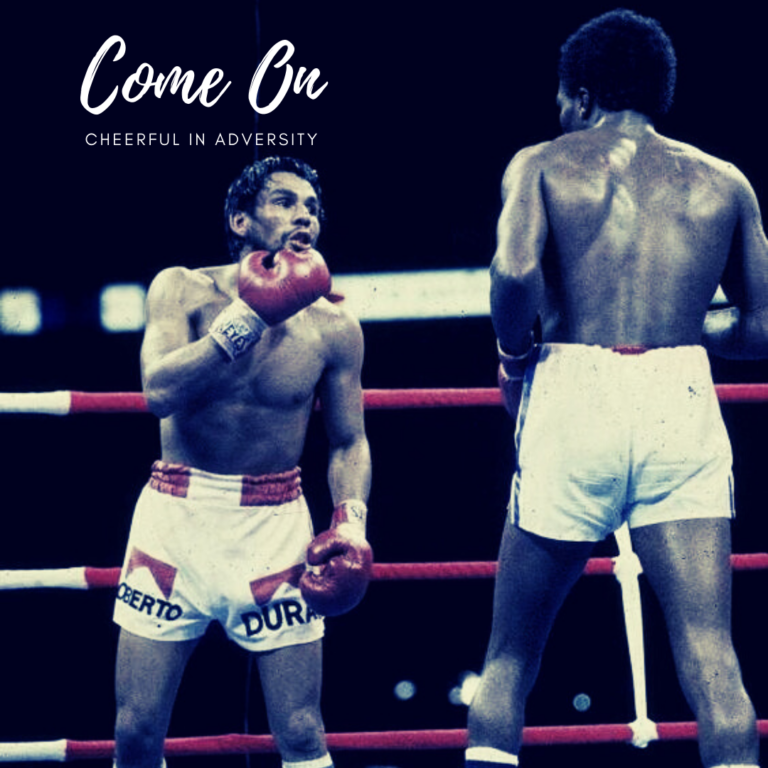
Check out the match: CLICK HERE

What was your favourite quote or lesson from this episode? Please let me know in the comments.

SCROLL BELOW FOR LINKS AND SHOW NOTES…

SELECTED LINKS FROM THE EPISODE

SHOW NOTES

You’re listening to the Ultimate Youth Worker Podcast with your host, Aaron Garth [00:20]

Why youth workers need to think critically [00:30]

Asking questions is so important for critically reflective [02:30]

Two camps of youth worker supervisees [03:00]

Youth workers who look after other peoples children and can’t reflect on their practice  and are perplexed and angry [03:30]

This is distressing and is not really talked about in ethics statements [04:45] 

Supervision is core to ethical youth work practice [05:45]

The Munro Report [06:40]

Royal Commission into Institutional Responses to Child  Sexual Abuses – Final Report Recommendations [08:00]

Where is the accountability in ethics? [08:45]

The price of being a professional [10:00]

The struggle of supervision [12:00]

Yes, you should be checked up on, and supported [13:30]

We aren’t able to do everything and we shouldn’t [15:30]

If you are not taking supervision you are simply not professional [17:00]

Supervision is about being open, honest and kind [19:00]

Youth work doesn’t begin and end at the white cliffs of Dover [20:30]

Youth work is not dying but it is changing [23:00]

Youth works gift is walking benignly with young people [25:10]

We need to be true to ourselves to be the critically reflective profession we need to be [26:50]

Adventure, chances and the mountain top [30:00]

SOME QUOTES FORM THE EPISODE

“Most youth workers I’ve come across seem to act like 3rd rate teachers, clueless social workers, amateur psychiatrists (kiddie curers) or jaded child minders”. – Julian, paediatric nurse

“If we’re not thinking about it who is? It’s going to be those other professions. It’s going to be the paediatricians, and the social workers, and the psychologists, and the police and everyone else. And they will probably look at us with a bit of ire there, that we are trying to do so many things. We’re Jacks and Jills of all trades, but what are we really mastering?” – Aaron Garth

Maybe you’re right. Maybe we should be more critically reflective about asking people to be critically reflective” – Brian Belton

Looking after other peoples children, whatever I am doing with them, they are other peoples children;  And I am not capable of thinking about what I am doing. I am just doing… and I do my best. The moment you question me about that, one, I am perplexed, wondering why you asked me. Two, I’m a little bit angry that you asked me. – Brian Belton

You see thats what I find quite distressing on two levels. On a safeguarding level, what are you doing and what you hiding and why do you feel that way? and on another level it feels unfortunate that that person is in a place where they can’t think about what they are doing for whatever reason” – Brian Belton

“It is core to the reflective activity of youth work, supervision” – Brian Belton

“If there is no accountability and there is no way someone can be de-barred from practicing then there is no ethics. You cant have a code of ethics with no agreed accountability” – Brian Belton

“You Should be checked up on. You should want to be checked up on” – Brian Belton

“[Supervision] is the sharing of  practice so we can do what we do better” – Brian Belton

“If you are not taking supervision you are simply not being professional” – Brian Belton

” If you’re not prepared to come and think about what you are doing with other peoples children and look at what you are doing openly and be enthusiastic to do it. I know it’s difficult. I know it’s hard. But, its part and parcel of what you do. and if you cant do it, or you refuse to do it, for whatever reason then you shouldn’t be doing this work” – Brian Belton

“Unless we are not talking about supervision, we are remiss” – Brian Belton

“Actually, there are more youth workers on the planet than any other time in history” – Brian Belton

“We are pretty good at having a whinge as youth workers. It’s easy for us to do. Perhaps the harder but more productive thing is to be critically reflective and ask a few questions of ourselves” – Aaron Garth

“You can demand applause and demand appreciation, but it ain’t going to come” – Brian Belton

“Joy will get us through. Fear will destroy us” – Brian Belton

PEOPLE MENTIONED IN THE PODCAST

Thanks for Listening!

To share your thoughts:

  • Share this cast with a friend or colleague.
  • Leave a note in the comment section below.
  • Share this show on TwitterFacebook, or Pinterest.

To help out the show:

  • Leave an honest review on iTunes. Your ratings and reviews really help the podcast and we read each and every one.
  • Subscribe on iTunes.
Aaron Garth

Aaron Garth

Aaron Garth is the Executive Director of Ultimate Youth Worker. Aaron has worked as a youth worker in a number of settings including local church, street drug and alcohol outreach, family services, residential care, local government and youth homelessness since 2003. Aaron is a regular speaker at camps, retreats, & youth work training events and is a dedicated to seeing a more professional youth sector in Australia. Aaron is a graduate of RMIT University and an alumnus of their youth work program. He lives in Melbourne with his wife Jennifer & their daughters Hope, Zoe, Esther, Niamh and son Ezra.

More Posts - Website

Follow Me:Add me on XAdd me on FacebookAdd me on LinkedInAdd me on PinterestAdd me on YouTube

Critical Youth Work

Podcast 042: Thinking Critically About Youth Work

Critical Youth Work

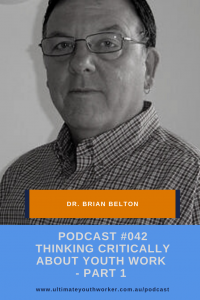
In todays episode of the Ultimate Youth Worker Podcast, “Thinking Critically About Youth Work: Part One”, Aaron speaks with Dr. Brian Belton about the need for youth workers to be critically reflective about who we are as professionals.

Over the years we have had some really great deep web chats with Brian, but this is the first face-to-face!! I mean he lives in the UK and Aaron is here in Australia! Critically thinking about youth work is something that both Brian and Aaron are very passionate about and we hope these two podcast sessions help you to re-think what you thought you knew about youth work.

Thinking Critically About Youth Work: Part 1

Podcast 042 Brian Belton

Brian Belton (FB: @Dr. Brian Belton LI: @Brian Belton) is an international consultant and academic specialising in youth work, supervision and identity studies. Previously he was the Director of International Education, Research and Training at the YMCA George Williams College, London.

Coming from an East London/Gypsy family, Brian played a leading role in the youth gang life of that area in the late 1960s/early 1970s.  While attending Burke Secondary Modern School, Plaistow, he had his brushes with the law (at times more of a large broom). However, with the guidance of Jesus (and a couple of tough but fair coppers) he entered youth work as a volunteer and part-time practitioner in the docklands of the late 1970s.

While working in youth work related situations around the world, including Israel, the Falkland Islands, Germany, the USA, Thailand, Hong Kong, Zambia, South Africa, China and Canada, Brian’s interest in identity and ethnicity flourished and today he is an internationally recognised authority on Gypsy Ethnicity, and the rights of Roma in Europe, having written widely on that subject, delivering papers most recently in the USA, Austria, Greece, Sweden and Slovenia as well as around the UK.  In has recently concluded a three year research programme focusing on the social exclusion of Roma with partners in Spain, Germany and Turkey.

Gaining his professional qualification from the YMCA College and went on to became a Senior Youth Worker in Bethnal Green, employed by the ILEA before achieving a BSc at City University.  Returning to the ILEA he took charge of a major community project in Islington. Spending some time as an area youth officer, Brian successfully completed Masters studies at the University of Essex.

On joining the staff of the George Williams College he started his doctoral work, and gained a PhD in 2000

Currently Brian is developing a growing, worldwide network of practitioners and academics concerned with the exploration of youth work and is starting a project looking to develop a profile of youth work across European Commonwealth Countries, in association with the Commonwealth Secretariat.

Please enjoy this podcast!

Dr. Brian Belton

What was your favourite quote or lesson from this episode? Please let me know in the comments.

SCROLL BELOW FOR LINKS AND SHOW NOTES…

SELECTED LINKS FROM THE EPISODE

SHOW NOTES

You’re listening to the Ultimate Youth Worker Podcast with your host, Aaron Garth [00:20]

Dr. Brian Belton Biography [01:30]

Paediatric Nurse Julian frames how he has seen youth workers [06:30]

A good number of people were defensive about youth work [09:30]

Lets think about this… [09:40]

First comment from Sarah [10:30]

Chris Comment [10:47]

Asking the right questions about doing youth work [12:30]

Is doing our best at thing that we aren’t good at a good idea? [14:00]

School/youth work project [15:00]

Jacks and Jills of all trades [17:30]

Policy and law missing from youth work education [17:45]

Youth work as a colonial experience [19:00]

Youth work should not be clandestine [23:00]

Youth work and empowerment [24:00]

Authority, Responsibility and Power [26:20]

Youth work is a journey [30:45]

SOME QUOTES FORM THE EPISODE

“Most youth workers I’ve come across seem to act like 3rd rate teachers, clueless social workers, amateur psychiatrists (kiddie curers) or jaded child minders”. – Julian, paediatric nurse

“I think what he [Julian] was talking about is how we have been corralled” – Brian Belton

“We need probably to think a little bit harder about what we want to be, what we can be and what we should be” – Brian Belton

“If anything worries me a little if i am serious, it worries me that if we can’t look at our practice in this way, in this reflective critical manner” – Brian Belton

“Too much agreement kills a chat” Elderidge Cleaver

“Why do we want to do what you might call our best? Isn’t there a case for actually asking the whole question about doing stuff?” – Brian Belton

“The idea that we can be all things to all people and that we should be congratulated for just doing our best, seems to me to be very misguided”- Brian Belton

“i’ve often talked about youth workers as being, we’re sherpas. We walk alongside you. We carry a bit of the load. So that you can take YOUR journey. Whatever journey that is. Whichever mountain YOU are going to climb” – Aaron Garth

PEOPLE MENTIONED IN THE PODCAST

Thanks for Listening!

To share your thoughts:

  • Share this cast with a friend or colleague.
  • Leave a note in the comment section below.
  • Share this show on TwitterFacebook, or Pinterest.

To help out the show:

  • Leave an honest review on iTunes. Your ratings and reviews really help the podcast and we read each and every one.
  • Subscribe on iTunes.

Join the Ultimate Youth Worker Community

If you are looking to be a more principled, passionate and professional youth worker then this is the community for you. Get regular podcasts, blog posts, training opportunities and much more. 

Join now
Aaron Garth

Aaron Garth

Aaron Garth is the Executive Director of Ultimate Youth Worker. Aaron has worked as a youth worker in a number of settings including local church, street drug and alcohol outreach, family services, residential care, local government and youth homelessness since 2003. Aaron is a regular speaker at camps, retreats, & youth work training events and is a dedicated to seeing a more professional youth sector in Australia. Aaron is a graduate of RMIT University and an alumnus of their youth work program. He lives in Melbourne with his wife Jennifer & their daughters Hope, Zoe, Esther, Niamh and son Ezra.

More Posts - Website

Follow Me:Add me on XAdd me on FacebookAdd me on LinkedInAdd me on PinterestAdd me on YouTube

Work with the Young Person as the Focus

Work with the Young Person as the Focus

I was recently looking at the Certificate IV in Youth Work training package and wondering the age old question of what makes how youth workers engage with young people different. Different from social workers, teachers, student welfare professionals, mental health workers and all the other professions and para-professions that work with young people. It is an age old question in youth work. What do we do? How is this different from everyone else. In fact it is probably the foremost question of our professionalisation debate. The sad fact of the matter is that most youth workers cannot agree on the core tenets of youth work as a profession. It was with all this rattling around in my head when I came across one performance element in the very first youth work unit and my mind was changed, work with the young person as the focus. If youth work students could just fully get this then all the other debates become minutia.

The third performance criteria states that one of the areas of knowledge and skills that a youth worker must hold is to “work with the young person as the focus“. Now, this may seem like a foundational piece of knowledge and it is, after all it is in the first youth work unit of the Certificate IV (CHCYTH001 Engage Respectfully with Young People). It is also a fundamental skillset that many youth workers forget, or worse are required to dismiss. 

You see there are many people in the world who want to guide our young people. For the most part these people have good intentions. Teachers want students to learn so they can get a job and live as part of society. Parents want their children to be safe. Student welfare staff want young people to have the language, literacy and numeracy skills to graduate. However, do they put the young person first? do they work for the young person as the focus? do they have other motives?

This is the key to great youth work ethos as well as exceptional youth work praxis. I will go into more depth below, but in the mean time lets get back to what the training package informs us about this. There are six performance criteria that youth work students must demonstrate here to be deemed to have the knowledge and skills to be a youth work graduate. They are:

  1. Apply youth-centred practices when working with young people 
  2. Respect the rights, needs and responsibilities of the young person 
  3. Explain worker rights and responsibilities to the young person as necessary 
  4. Establish a professional relationship and boundary expectations with the client 
  5. Identify and manage power inequities in the professional relationship 
  6. Apply principles of ethical decision-making in working with young people 
 
Engage Respectfully with Young People

How do we work with young people as the focus?

Apply youth-centred practices when working with young people 

The Youth worker needs to demonstrate that they have a solid grasp on youth-centred practices and how to implement these with young people. This begs the question, what are youth-centred practices? A few that spring to mind are ‘youth engagement’, ‘youth participation’ and Carl Rogers ‘person centred therapy’. There are a few more, but the idea here is the young person needs to be at the centre of the activity of youth work. So, if the young person is not at the centre of your work, you probably aren’t doing youth work. 

Respect the rights, needs and responsibilities of the young person 

We must have a rights based approach to youth work. The Victorian Youth Work Code of Ethics is explicit about this approach. We as youth workers are very much informed by the United Nation Convention on the Rights of the Child in our dealings with young people. We are also needs based. It is about what our young people need, not their mum, dad, teacher or the local constabulary. The space of responsibilities is a contentious issue for youth workers and is linked heavily to the rights side of things. Here in Victoria we have a Charter of Rights and Responsibilities, it states,  “in protecting the rights of a person there is a corresponding duty to other individuals or the wider society to act responsibly towards them“. As youth workers this means we have the responsibility to protect our young peoples rights, it is not our young peoples responsibility.

Explain worker rights and responsibilities to the young person as necessary 

As youth workers we have many rights and responsibilities. One of our rights is to be safe in our workplace. This is enshrined in work health and safety legislation. Another right is to be paid for our work. These rights and more also come with some responsibilities. Responsibilities such as holding a duty of care, being a fit and proper person and looking out for their safety. Our young people must hear and understand these things. We might even give them an information sheet that explains them.

Establish a professional relationship and boundary expectations with the client 

In his most excellent book “Youth Work Ethics” Professor Howard Sercombe states, “the {youth work] relationship is intentionally limited“. He goes on further to state, “It is a partnership in that space… in which youth worker and young person work together to heal hurts, to repair damage, to grow into responsibility an to promote new ways of being“(2010, p.11). This is one of the most useful steps in the youth work relationship as it clearly identifies to the worker and young person what can and can’t be part of the relationship. We identify timelines for support, clearly identify agreed expectations and put up barriers for protection. This has become an even more important step in Australian youth work since the Royal Commission into Institutional Abuse.

Identify and manage power inequities in the professional relationship 

As youth workers we must recognise that we have power over young people. We might try to minimise its effect, but it is there. How we go about identifying this, potentially with our young people and then managing it is central to being able to build and maintain out relationship. One key way to do this well is to have regular supervision where you are challenged about this.

Apply principles of ethical decision-making in working with young people

Having a code of ethics is a really important step for professional youth work. However the document is useless unless it is put into practice. As youth workers we need ethical decision-making frameworks to help us navigate the murky waters of youth work practice. One clear decision imperative is that our young people are our primary consideration, or as the training package puts it we work with the young person as the focus. We are big fans of Virtue Ethics at Ultimate youth Worker and we use this extensively in our work, however there are a number of ethical decision frameworks that can help us to put our young people at the centre of our decision making processes.


If we are to take youth work to the heights of professionalism we must be able to identify what makes us unique. One of the very clear practices that sets us apart is how we view those we work with. Not as helpless clients but as young people free to determine their futures. For us to engage respectfully with them it must not be from a stance of the all knowing adult. We often say to youth workers that our job is that of a sherpa. We are a knowledgable guide who walks alongside young people and we help to carry the load occasionally while they strive to reach the top of the mountain they are climbing at the time.

Join the Ultimate Youth Worker Community

If you are looking to be a more principled, passionate and professional youth worker then this is the community for you. Get regular podcasts, blog posts, training opportunities and much more. 

Join now
Aaron Garth

Aaron Garth

Aaron Garth is the Executive Director of Ultimate Youth Worker. Aaron has worked as a youth worker in a number of settings including local church, street drug and alcohol outreach, family services, residential care, local government and youth homelessness since 2003. Aaron is a regular speaker at camps, retreats, & youth work training events and is a dedicated to seeing a more professional youth sector in Australia. Aaron is a graduate of RMIT University and an alumnus of their youth work program. He lives in Melbourne with his wife Jennifer & their daughters Hope, Zoe, Esther, Niamh and son Ezra.

More Posts - Website

Follow Me:Add me on XAdd me on FacebookAdd me on LinkedInAdd me on PinterestAdd me on YouTube

Podcast 041: Listen to Engage

In todays episode of the Ultimate Youth Worker Podcast, “Listen to Engage”, Aaron speaks to us about the need for youth workers to listen respectfully to their young people. One of the keys to developing respectful engagement with our young people is the skill of listening to gain understanding of how they view their experiences.

Listen to Engage

We have two ears and one mouth, so the proverb goes, so listen twice as much as you speak. As youth workers we engage in a relational profession. We speak, we listen, we engage. Unfortunately, we can sometimes forget this. We listen to inform our young people of our opinions. We refute or rebut their view of their experiences. To answer before listening is our folly and our shame. Even fools are thought wise if they keep silent. For us to engage respectfully we need to put our young people at the centre of our engagement. Treat them with dignity, understand their experiences from their point of view and respect their autonomy

Six steps to good engagement

Here are a few tips that will help you to engage respectfully with your young people. When having a conversation it is extremely important to listen well.

Pay attention

It is easy for our minds to wander. If we do not pay attention it is impossible to engage well. We need to be active listeners. Use our minimal encouragers. Look them in the eyes when they make their points. Focus on what they are saying. Actively listen.

Hold your judgements

Hold your tongue, your beliefs and judgements. This is key to relational practices. What we think is not important here. It is all about being focused on the young person.

Reflect on what has been said

Take time to think. You do not have to speak straight away. Let what has been said truly sink in to your brain and heart.

Clarify

Seek first to understand before you seek to be understood. Make sure you understand what has been said. If you are unsure ask questions to clarify.

Summarise

Once you have paid attention, held your judgement, reflected on what had been said and clarified any misunderstanding this is a good time to summarise and paraphrase what has been said to make sure you have fully understood your young person.

Share

If you have done all of these things then you will have earned the right to speak into the lives of the young people.

Today’s resources

Here are links to some articles and training that have bearing on todays podcast:

Thanks for Listening!

To share your thoughts:

  • Share this cast with a friend or colleague.
  • Leave a note in the comment section below.
  • Share this show on TwitterFacebook, or Pinterest.

To help out the show:

  • Leave an honest review on iTunes. Your ratings and reviews really help the podcast and I read each one.
  • Subscribe on iTunes.

Before you go… Sign up to our newsletter

Subscribe

* indicates required


Email Format


Aaron Garth

Aaron Garth

Aaron Garth is the Executive Director of Ultimate Youth Worker. Aaron has worked as a youth worker in a number of settings including local church, street drug and alcohol outreach, family services, residential care, local government and youth homelessness since 2003. Aaron is a regular speaker at camps, retreats, & youth work training events and is a dedicated to seeing a more professional youth sector in Australia. Aaron is a graduate of RMIT University and an alumnus of their youth work program. He lives in Melbourne with his wife Jennifer & their daughters Hope, Zoe, Esther, Niamh and son Ezra.

More PostsWebsite

Follow Me:Add me on XAdd me on FacebookAdd me on LinkedInAdd me on PinterestAdd me on YouTube

Podcast 030: Self Care in Youth Work

Self Care in Youth Work

In this episode of the Ultimate Youth Worker Podcast ‘Self Care in Youth Work’ Aaron chats with Ex-Student Panel about self care in youth work. How do youth work practitioners leave work at work? Do relationships, boundaries and practices change when we engage in self care? What supports do youth workers need to be effective at self care? What happens when things go pear shaped?


Self Care in Youth Work

Youth work is all about relationships. We pride ourselves on being able to create and maintain positive relationships with young people where they can grow into the people they want to be. We focus so much of our attention on supporting young people by carrying their baggage while they scale their own developmental mountains. We are like Sherpas. This means we have to make sure we look out for ourselves so we can provide the best possible support (we need to be able to carry that load) to our young people.

If we don’t look after ourselves ultimately we can do more damage to our young people. Walking into the room burned out, frustrated, and with low tolerance to the difficulties life throws at us is not what our young people need from us. In order to give our best, we need to be at our best. This takes training and persistence. Self-care is not sexy. It is a long and difficult process that has its rewards in the journey and at the top of the mountain.

SO what have four youth workers learnt about self care in the day-in day-out struggles of the job after a few years in the field? How do they leave work at work and look out for their own self care?


Today’s resources

Here are links to some articles and training that have bearing on todays podcast.

Thanks for Listening!

To share your thoughts:

  • Share this cast with a friend or colleague.
  • Leave a note in the comment section below.
  • Share this show on TwitterFacebook, or Pinterest.

To help out the show:

  • Leave an honest review on iTunes. Your ratings and reviews really help the podcast and I read each one.
  • Subscribe on iTunes.

Before you go…

Aaron Garth

Aaron Garth

Aaron Garth is the Executive Director of Ultimate Youth Worker. Aaron has worked as a youth worker in a number of settings including local church, street drug and alcohol outreach, family services, residential care, local government and youth homelessness since 2003. Aaron is a regular speaker at camps, retreats, & youth work training events and is a dedicated to seeing a more professional youth sector in Australia. Aaron is a graduate of RMIT University and an alumnus of their youth work program. He lives in Melbourne with his wife Jennifer & their daughters Hope, Zoe, Esther, Niamh and son Ezra.

More PostsWebsite

Follow Me:Add me on XAdd me on FacebookAdd me on LinkedInAdd me on PinterestAdd me on YouTube

Debriefing after an incident

Podcast 029: Debriefing after an incident

Critical incident debrief

Critical Incident Debrief

In this episode of the Ultimate Youth Worker Podcast ‘Online Youth Work’ Aaron chats with us about how to conduct a critical incident debrief. We look at two models and unpack how individuals and teams can best use the debriefing process to look after themselves and reflect on the best ways forward.


As youth workers we find ourselves working with young people when they are at the best and when they are in their darkest places. When they are at their best we feel a sense of pride and live on the mountaintop. When they are in their darkest place we can see them in the depths of pain and the heights of anger. In their darkest place young people can be prone to making rash decisions. Sometimes, this can lead to young people lashing out, running away or in extreme cases they may harm themselves.

When a young person lashes out or injures themselves as youth workers we find ourselves in the midst of critical incidents. We deal with the circumstances as best we can. We keep as many people safe as we can. We provide first aid to those who need it. We call on emergency services such as the police or ambulance officers as the need arises. After all is said and done we find ourselves in front of the computer. Writing up an incident report.

What could have been hours of our lives, probably on our own, whittled down to a few pages in the hands of bureaucrats. For most of us that is about where it finishes. If you are lucky you may get to chat it over with your Team Leader or Manager who may even recommend that you use an Employee Assistance Program. Unfortunately, many EAP’s do not understand the work that youth workers are involved in and the sessions end up being less than useless. What we really need in this situation is a proper critical incident debrief.

At Ultimate Youth Worker we work with many organisations to implement a strong Critical Incident Stress Management (CISM) framework. We use and train others to use two different yet important models within a wider (CISM), the After Action Review and the Critical Incident Stress Debrief.

After Action Review

An After Action Review (AAR) is a process used by teams to recognise and understand the lessons learned from successes and failures, with the goal of improving future performance. It is an opportunity for a team to reflect on an incident, activity, event or task so that they can do even better the next time. AARs should be carried out with an open spirit and without blame. The Army use the phrase “leave your rank at the door” to remove blocks to involvement whilst optimising learning through the process. One member of the group facilitates, capturing results on a flip chart or in a document.

After Action Review is a form of group reflection where participants review four things:

  • what was intended
  • what actually happened
  • why it happened and
  • what was learned.

Critical Incident Stress Debrief

Critical Incident Stress Debrief is narrowly defined in scope and intent as part of a more comprehensive CISM. CISD is strategically focused on the detailed disclosure of facts, thoughts, and emotional reactions and sensory material linked to a particular traumatic event (or “incident”). It is often seen in the literature as psychological first aid and is generally carried out within 48 hours after an incident. This is not counselling or psychotherapy (however that may be part of a fully developed CISM).

The steps to a Critical Incident Stress Debrief include:

  1. Assess (audit) the impact of the critical incident on support personnel and survivors
  2. Identify immediate issues surrounding problems involving “safety” and “security”
  3. Use defusing to allow for the ventilation of thoughts, emotions, and experiences associated with the event and provide “validation” of possible reactions
  4. Predict events and reactions to come in the aftermath of the event
  5. Conduct a “Systematic Review of the Critical Incident” and its impact emotionally, cognitively, and physically on survivors. Look for maladaptive behaviours or responses to the crisis or trauma
  6. Bring “closure” to the incident “anchor” or “ground” support personnel and survivors to community resources to initiate or start the rebuilding process (help identify possible positive experiences from the event)
  7. Debriefing assists in the “re-entry” process back into the community or workplace. Debriefing can be done in large or small groups or one-to-one depending on the situation. Debriefing is not a critique but a systematic review of the events leading to, during, and after the crisis.

Today’s resources

Here are links to some articles and training that have bearing on todays podcast.

Thanks for Listening!

To share your thoughts:

  • Share this cast with a friend or colleague.
  • Leave a note in the comment section below.
  • Share this show on TwitterFacebook, or Pinterest.

To help out the show:

  • Leave an honest review on iTunes. Your ratings and reviews really help the podcast and I read each one.
  • Subscribe on iTunes.

Before you go…

Sign up to our newsletter

Aaron Garth

Aaron Garth

Aaron Garth is the Executive Director of Ultimate Youth Worker. Aaron has worked as a youth worker in a number of settings including local church, street drug and alcohol outreach, family services, residential care, local government and youth homelessness since 2003. Aaron is a regular speaker at camps, retreats, & youth work training events and is a dedicated to seeing a more professional youth sector in Australia. Aaron is a graduate of RMIT University and an alumnus of their youth work program. He lives in Melbourne with his wife Jennifer & their daughters Hope, Zoe, Esther, Niamh and son Ezra.

More PostsWebsite

Follow Me:Add me on XAdd me on FacebookAdd me on LinkedInAdd me on PinterestAdd me on YouTube

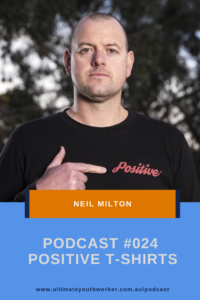
Positive T-Shirts

Podcast 024: Positive T-Shirts

Founder Positive T-Shirts

Neil Milton is the founder of Positive T-Shirts which is a social enterprise-giving all profits towards preventing youth suicide. Neil is a public speaker, motivator and novice social media junky. Neil also is the General Manager for another not-for-profit working to prevent harm and abuse of children. He has worked in some of the roughest schools in Adelaide as a youth worker and has also had a stint working for life line.

His motto in life is “one day at a time”

Neil enjoys hanging out with his wife and children, also exercising, when he gets out of bed!

Positive T-Shirts

The Positive T-Shirt brand birthed in 2016 out of a passion to create t-shirts and other apparel that literally change lives as you wear it and as others see it. That’s why profits of products sold go towards preventing youth suicide.

All profits raised are donated to in2life which helps fund the training of volunteers who support young people, through their facebook group ‘coming together to prevent youth suicide‘. Donations also support school programs enabling young people with the skills needed to help their friends, who may be struggling.

In todays episode of the Ultimate Youth Worker Podcast Aaron speaks with Neil about his journey to founding Positive T-Shirts. We discuss why Neil decided to support the cause of suicide prevention and how you can get a great bit of merchandise to aid the cause.


Today’s resources

Here are links that have bearing on todays podcast.

Contact Neil and the Positive T-Shirt team

Thanks for Listening!

To share your thoughts:

  • Share this cast with a friend or colleague.
  • Leave a note in the comment section below.
  • Share this show on TwitterFacebook, or Pinterest.

To help out the show:

  • Leave an honest review on iTunes. Your ratings and reviews really help the podcast and I read each one.
  • Subscribe on iTunes.
Aaron Garth

Aaron Garth

Aaron Garth is the Executive Director of Ultimate Youth Worker. Aaron has worked as a youth worker in a number of settings including local church, street drug and alcohol outreach, family services, residential care, local government and youth homelessness since 2003. Aaron is a regular speaker at camps, retreats, & youth work training events and is a dedicated to seeing a more professional youth sector in Australia. Aaron is a graduate of RMIT University and an alumnus of their youth work program. He lives in Melbourne with his wife Jennifer & their daughters Hope, Zoe, Esther, Niamh and son Ezra.

More PostsWebsite

Follow Me:Add me on XAdd me on FacebookAdd me on LinkedInAdd me on PinterestAdd me on YouTube

ChildSafe

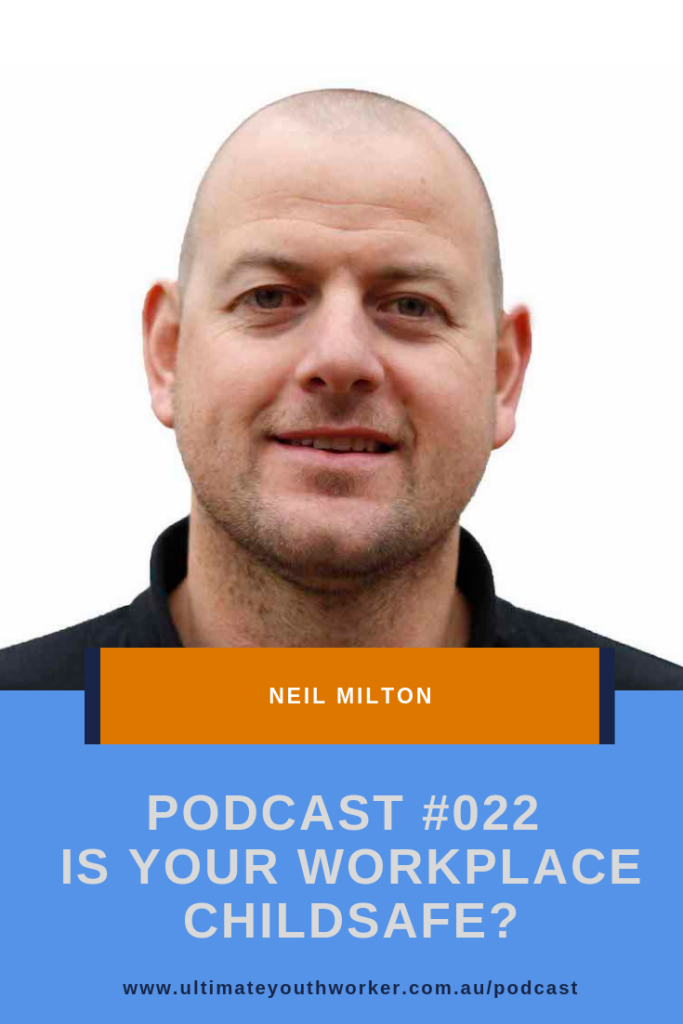
Podcast 022: Is your workplace ChildSafe?

Is your workplace ChildSafe?
  To support the podcast, you can donate here.

Is your workplace ChildSafe?

In this episode of the Ultimate Youth Worker Podcast ‘Is your workplace ChildSafe?’ Aaron speaks with Neil Milton about how we as youth workers can support young people by being ChildSafe. Neil Milton is the General Manager of ChildSafe. Neil has worked as a youth worker in schools, churches and Not for Profits across Australia. He has also worked for World Vision and has his own street clothing business helping prevent youth suicide. Neil is passionate about making sure children are protected from abuse and harm and that organisations know their responsibilities in regards to child safety. Neil is a public speaker, motivator and he enjoys exercising and hanging out with his wife and kids.

In todays episode Aaron and Neil speak about the work of ChildSafe Australia and their mission to serve organisations and individuals working with children and vulnerable people, with the goal of improving their well-being and safety. We take our commitment to child safety very seriously at Ultimate Youth Worker and have used many of the resources from ChildSafe to help us in making our commitment tangible.

ChildSafe is “a harm prevention charity for the promotion of the prevention and control of behaviour that is harmful or abusive to children and young people when in the care of an organisation”. Children and young people deserve the best endeavours of an organisation towards their safety. This involves more than good intentions, or the assumption that harmful incidents will not happen. Organisations working with children are under increased community scrutiny in relation to screening workers, risk management and the quality of care they offer.

You can find more information about Neil on LinkedIn.

Today’s resources

Here are links to some articles and training that have bearing on todays podcast.

Thanks for Listening!

To support the podcast, you can donate here.

To share your thoughts:

  • Share this cast with a friend or colleague.
  • Leave a note in the comment section below.
  • Share this show on TwitterFacebook, or Pinterest.

To help out the show:

  • Leave an honest review on iTunes. Your ratings and reviews really help the podcast and I read each one.
  • Subscribe on iTunes.
  • Do the online ChildSafe Training

Aaron Garth

Aaron Garth

Aaron Garth is the Executive Director of Ultimate Youth Worker. Aaron has worked as a youth worker in a number of settings including local church, street drug and alcohol outreach, family services, residential care, local government and youth homelessness since 2003. Aaron is a regular speaker at camps, retreats, & youth work training events and is a dedicated to seeing a more professional youth sector in Australia. Aaron is a graduate of RMIT University and an alumnus of their youth work program. He lives in Melbourne with his wife Jennifer & their daughters Hope, Zoe, Esther, Niamh and son Ezra.

More PostsWebsite

Follow Me:Add me on XAdd me on FacebookAdd me on LinkedInAdd me on PinterestAdd me on YouTube

Non-Suicidal Self Injury

Podcast 020: Non-Suicidal Self Injury (Part One)

Non-Suicidal Self Injury
To Support the Podcast, you can donate here.

Non-Suicidal Self Injury

In this episode of the Ultimate Youth Worker Podcast ‘Non-Suicidal Self Injury Part One’ Aaron speaks with Dr. Claire Kelly about her work at Mental Health First Aid Australia and in particular her work in the space of Non-Suicidal Self Injury.

Dr Claire Kelly is the Director of Curriculum at MHFA Australia and an Honorary Fellow at Deakin University. Claire has been involved with MHFA since 2003, when she first became an instructor while completing her Doctorate at the Centre for Mental Health Research at the Australian National University in Canberra, where the program was first developed. Prior to her current position, Claire was the Youth MHFA Programs Manager for 10 years and also worked on the MHFA Guidelines used to develop Edition 2 of MHFA and YMHFA. Claire’s PhD thesis was written on the mental health literacy of Australian adolescents. Her main passion is the mental health of young people and minimising the impacts that mental health problems can have on development, educational outcomes and long-term functioning. Claire has suffered episodes of depression and anxiety since adolescence, which has been a driver for this work.

In todays episode (Part One of Two) Aaron and Claire speak about Non-Suicidal Self Injury and the MHFA guidelines for non-Suicidal Self Injury developed by Mental health First Aid Australia after their ‘Delphi study’ into this area.

Professional youth workers understand that there are many young people who are hurting so bad that they self injure to deal with the turmoil. Unfortunately, not all professional youth workers know how to provide the support these young people need. Todays podcast begins to give us the tools to help the hurt and keep our young people safe.

You can find more information about Claire on LinkedIn.

Today’s resources

Here are links to some articles that have bearing on todays podcast.

Thanks for Listening!

To support the podcast, you can donate here.

To share your thoughts:

  • Share this cast with a friend or colleague.
  • Leave a note in the comment section below.
  • Share this show on TwitterFacebook, or Pinterest.

To help out the show:

Aaron Garth

Aaron Garth

Aaron Garth is the Executive Director of Ultimate Youth Worker. Aaron has worked as a youth worker in a number of settings including local church, street drug and alcohol outreach, family services, residential care, local government and youth homelessness since 2003. Aaron is a regular speaker at camps, retreats, & youth work training events and is a dedicated to seeing a more professional youth sector in Australia. Aaron is a graduate of RMIT University and an alumnus of their youth work program. He lives in Melbourne with his wife Jennifer & their daughters Hope, Zoe, Esther, Niamh and son Ezra.

More PostsWebsite

Follow Me:Add me on XAdd me on FacebookAdd me on LinkedInAdd me on PinterestAdd me on YouTube