
In todays Ultimate Youth Worker Podcast “the sociological imagination”, Aaron gets us thinking about the need for youth workers to see more than just the individual young person. We look at the work of Sociologist C. Wright Mills and how it relates to youth work. Here are the shownotes.
Welcome back to the Ultimate Youth Worker Podcast for 2017. We are stoked to have you with us and we hope that your youth work journey is inspiring you to great things. We know its not easy to be a youth worker in the current climate and to all of you who are struggling to keep your jobs and defend the practices of youth work we salute you.
The struggles that we are facing currently in youth work are ideologically driven. We are seeing the tightening grip of neoliberalism on the social sector as a whole. We are hearing the ongoing rhetoric that youth work is not professional. We are also seeing the challenges of public perception of our practice. Amongst all of this we need to remember that we have a strong foundation from which to stand and leverage our work.
Youth work as we know it across the globe sprung forth from diverse fields which has led to contentious issues of our knowledge frameworks ever since. One of the underpinning theoretical frameworks which guides the practices of youth work is that of Sociology. It helps us to look more deeply at the world our young people live, work and play within. One of the key thoughts within Sociology is the sociological imagination. The ability to look at an issue from an individual and social perspective. So let’s find out more about this key framework and how it fits within youth work.
C. Wright MILLS
American Philosopher and Sociologist, Charles Wright Mills was a Professor of Sociology at Columbia University from 1946 until his death in 1962, aged 45. Mills, a native Texan, was published widely throughout his career in popular and intellectual journals, and is a proponent of the conflict perspective within sociological thought. Mills was concerned with the responsibilities of intellectuals in post-World War Two society, and advocated public and political engagement over disinterested observation.
Mills sociological work was heavily influenced by eminent German conflict theorists and fathers of sociology Karl Marx and Max Weber.
Mills is remembered for several books, among them ‘The Power Elite’, which introduced that term and describes the relationships and class alliances among the U.S. political, military, and economic elites; ‘White Collar’, on the American middle class; and ‘The Sociological Imagination’, where Mills presents a model of analysis for the interdependence of subjective experiences within a person’s biography, the general social structure and historical development.
Overview of the sociological imagination
In 1959 one of the most important texts in sociological work was published by Oxford University Press. The book by American Sociologist C. Wright Mills “The Sociological Imagination” changed the landscape of sociological thought and research forever.
Mills conveyed that the core undertaking for sociology as a discipline and sociologists particularly was to discover and express the connections between the particular social environments of individuals (also known as “milieu”) and the wider social and historical forces in which they are embroiled. This approach challenges the structural functionalist approach to Sociology, as it opens new positions for the individual to occupy with regard to the larger social structure. Individual function that reproduces larger social structure is only one of many possible roles, and is not necessarily the most important. In Mills own words, “The sociological imagination enables us to grasp history and biography and the relations between the two within society. That’s its task and its promise”.
In ‘The Sociological Imagination’, Mills endeavoured to reconcile two abstract conceptions of social reality—the “individual” and “society”—and thereby confronted the dominant sociological discourse of functionalism. In essence he asked where the convergence point is between an individual’s ‘personal troubles’ and societies ‘public issues’.
Private issues
Mill work on the sociological imagination looked at the dominant discourse of individuality which had grown since the second world war and sought to understand the framework of an individual’s ‘personal troubles’. These private issues which are said to have nothing to do with the rest of society such as what you eat, who you vote for, which religion you follow or what type of job you have. For Mills these private issues were not just the sole purview of the individual, but a complex system of interweaving thought and ideas from everywhere.
Public issues
This interweaving system is what Mills coined as public issues. Why is it that individuals in poor communities seem to have children who follow in the same footsteps as their parents? Mills argues that it has little to do with the individual’s choices and much more to do with the systems and the power of the elites which guide the forces around the individual. There is an intricate relationship between the individual and society.
Example
An individual person becoming unemployed is a personal trouble, one million people becoming unemployed is a public issue. But what makes them personal or public? If the issue affects an individual or a small group that is a personal trouble. If it affects a significant proportion of society it is a public issue.
Family violence had historically been seen as a private issue. It was seen as only affecting that family. However we know that family violence is visited on a significant proportion of the population so it is really a public issue.
What does this mean for youth workers?
Well first and foremost it gives us a lens to look at what our clients need. Do they require individual support of wider advocacy? In the case of family violence probably both. In the case of unemployment an individual may need retraining and support around interviewing. If it is a larger issues such as the slow death of manufacturing then advocacy and innovative redistribution may be needed. The sociological imagination asks us to recognise where the problem lies.
The second thing is that we need to be skilled in personal support and as change makers. We need to know how to support our individual clients in the space where they are at. We also must become fluent in community development and activism. Currently, the youth sector in the Uk is being squeezed. The issues are personal for the young people losing support, and the youth workers losing jobs. They are also public issues as millions of dollars are pulled from a sector designed to help the most vulnerable and generalist youth work is under siege.
Finally, it gives us a useful language to speak into these situations which is clearly defined. It is a language which is hard to ignore and it is a language which is shared in the sector.
Lets recap.
C. Wright Mills coined the term sociological imagination in 1959. It seeks to understand the personal troubles and public issues which define humanity. It asks us to think about issues through the lens of both the individual and the system. It asks us to understand the effects on the person. It asks for action.
Conclusion
We hope that todays cast on the sociological imagination has given you something to think about. We believe that if youth workers remember some of our sociological roots it will help us to be the best supports for our young people that we can. If you found this cast helpful or you have any questions touch base with us on our facebook page facebook.com/ultimateyouthworker
Stay frosty, and we will see you in the next episode of the Ultimate Youth Worker Podcast.

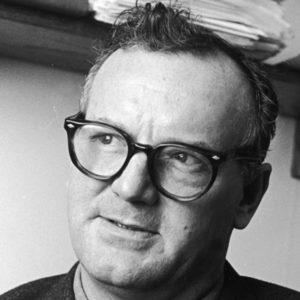 American Philosopher and Sociologist, Charles Wright Mills was a Professor of Sociology at Columbia University from 1946 until his death in 1962, aged 45. Mills, a native Texan, was published widely throughout his career in popular and intellectual journals, and is a proponent of the conflict perspective within sociological thought. Mills was concerned with the responsibilities of intellectuals in post-World War Two society, and advocated public and political engagement over disinterested observation.
 In 1959 one of the most important texts in sociological work was published by Oxford University Press. The book by American Sociologist C. Wright Mills “The Sociological Imagination” changed the landscape of sociological thought and research forever.
 To begin with I think we need to re-evaluate where we are at and where we want to be. For the last few years we have rested on the academic work of he last decade to frame our arguments around professionalism. There has been a glaring omission in this research, the voice of the youth worker. For the most part the work on the development of professional youth work in Australia has been the purview of academics, peak bodies and industry groups. We need to hear what those on the front line want from a professional association. We also need to ask what this association would look like?
 Liberation is a key focus of youth work theory and is a focus we should consider in professionalising. Harvard University academic Rosabeth Moss Kanter says that when we do change to people, they experience it as violence, but when people do change to themselves, they experience it as liberation. There are currently three groups in the debate; those who are in favour of professionalising, those who are against professionalising and those who are apathetic to the whole debate. None of these groups are experiencing liberation.
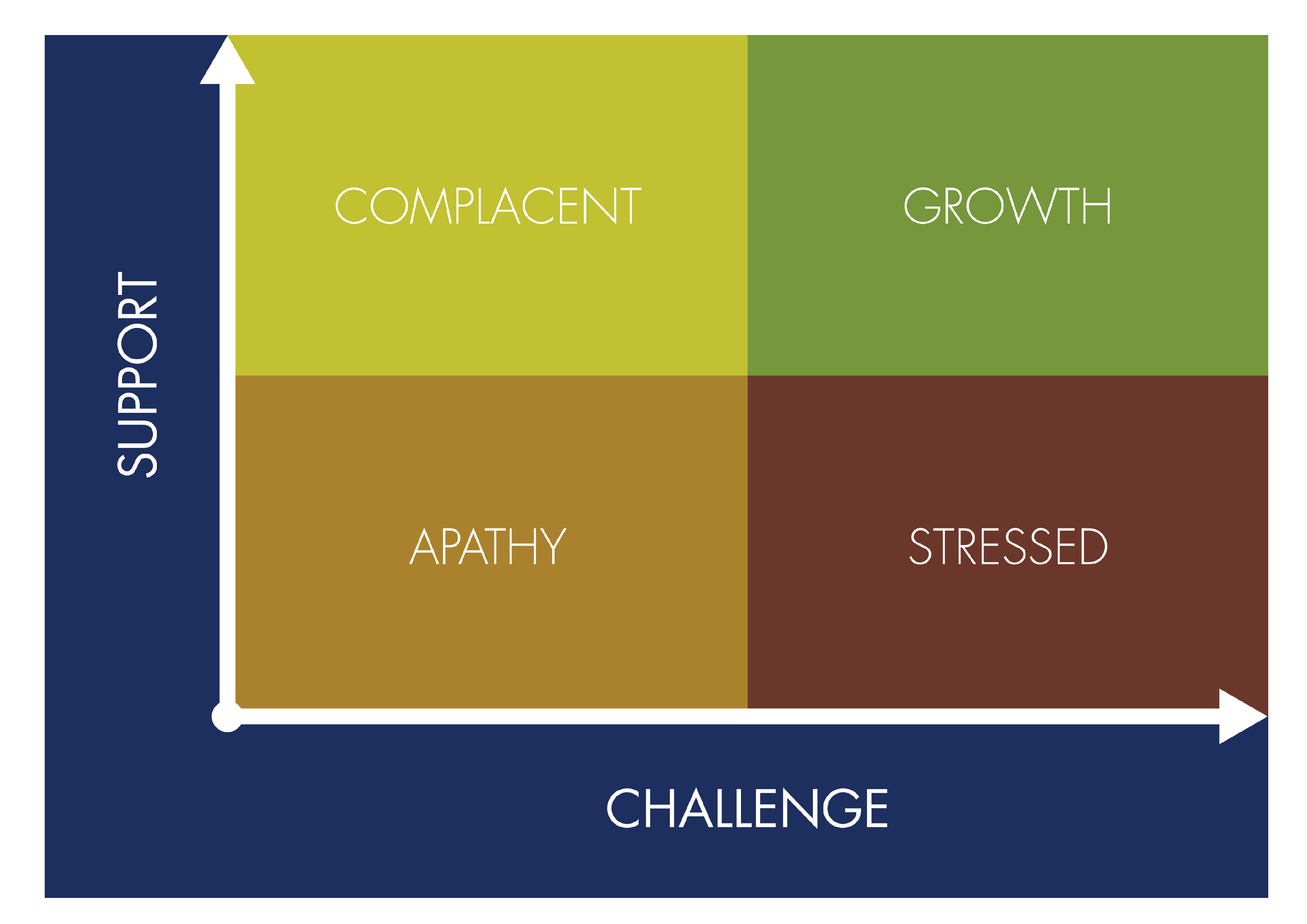 We love this Quadrant Matrix as it so easily sums up the issues we hear every day. As you can see there are two Axis: Challenge and support. These two axis are broken down to four quadrants.
 You need more supervision!
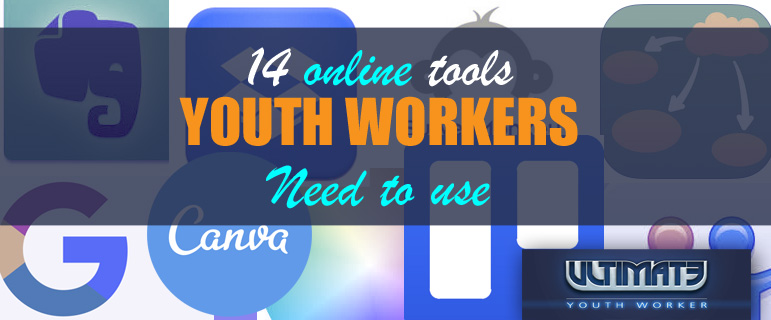 Online tools you need
 Evernote is one of the great online tools for organising all of your thoughts. It is like having a notebook in your pocket that you can put ideas into quickly and easily without needing a pen and paper. You can arrange your notes into ‘Notebooks’ to easily combine relevant ideas together. It takes pictures, adds weblinks, allows you to set reminders and even draw pictures. If you’re like me and have ideas about many topics and you have scrap paper or multiple notpads everywhere this program is for you.
 I was presenting off site last week when the USB I had my presentation on died. Completely fried. I almost went into a melt down. What was I going to do. Enter Dropbox. I called a colleague and had them drop the presentation into our Dropbox and with the help of the internet gods it was there when I logged in. Dropbox is a cloud based storage space where you can upload and download all manner of digital documents at the touch of a button. The free version gives you 2GB to use which is more than enough for most of us. Never be caught out again with great online tools!
 If you are like me you are graphically challenged. I cant draw and I struggle to use tools to get beautiful flyers out of my head and onto paper. A former student put me on to Canva, online tools for those of us who are graphically challenged that is literally already set up for us. Need a flyer for a program… Done. A Picture for Facebook about your event…Done. Literally any visual marketing you need all available at the click of a mouse.
 Our good friends at
  If you are a visual person you know all about mind mapping. Its an amazing way of getting thoughts out of your head and into some semblance of order. If you like lists a jumble of circles on a page makes no sense at all. Inspiration solves our communication problem. It takes either a list or a mind map and converts it for the other. I mind map when I am dreaming and visioning and then I click the button and I have a list of tasks to complete.
 If I have to sit through another presentation by someone who has just found Microsoft Powerpoint or Apples Keynote I may just explode. Boring presentations on basic themes with too many swishes, lets be honest we’ve all been there. Prezi takes the hard work out of designing a slide deck that looks good and has animation with its online tools. Some really cool templates with fill in fields turn a lackluster presentation into a wow instilling performance.
 More and more young people seem to experience mental health issues that need medication. When doing intake forms I would regularly hear the names of medications that I had no idea about. I’m not a pharmacist. What they do, what dosage is high or low, the common names and much more is at your fingertips with Psychdrugs. Easy to use and with most mental health medications listed this is a top tool.
 I have only recently been introduced to the amazing array of programs that google has in its arsenal. We all know the search engine is great and may even have a Gmail email account, but there is so much more to their online tools. spreadsheets, word processing, calendars, groups, hangouts, translate… The list goes on. If you are looking for free and amazing usability then the Google platform has it all.
 Keeping yourself educated is essential to great youth work practice. You should get more qualified than you are right now. If you cant commit to a course of study for some reason right now then iTunesU might be the thing for you. Download a podcast style uni course for free and listen in your car or on the train. There are hundreds of great courses that will help you become a great youth worker.
 Most services struggle to get feedback from their young people and when you stick a paper survey in their hand it usually ends in the bin. Survey Monkey is a free tool that alows you to create great surveys in minutes and send them via email, facebook, whatever system you want. The best bit is it aggregates all the data. You just need to read it.
 If you read a lot then you probably use Kindle. Bring all your books, journal articles, ebooks together in one space and get reading on the go. If you travel a bit it means you don’t have to pack heavy books in your bag. I struggle with reading on screens sometimes however you can deal with that for the ease of use and access to a huge library of content merely a click away. The kindle app for iPad is also a great investment.
 If you send emails or use facebook you have probably sent a link before. Most people just cut and paste and then you end up with lines of nonsense which are the link. Bitly can shorten the link into something much more manageable. It also has the added functionality of allowing you to see who clicks on the links and from where. Some features are paid but you don’t really need them if you are just shortening links.
 I am new to Trello but it has already significantly changed how I work. Trello lets you create separate boards for projects and then populate the boards with lists. Each list then gets cards. If you were doing a project you set up a board, Add topics to be done and then add list of steps under each topic. We use it for everything at Ultimate Youth Worker tracking workflow, developing podcasts, our intranet, you name it.
 If you create slide decks for young people why not put them on the internet so others can see them. It promotes your organisation and yourself and could end up helping people all around the world. Slideshare has become for slideshows what youtube is for videos. There is a myriad of information out there for us to use as well.