
Christian youth work and youth ministry carry big hopes for young people. One way to test whether those hopes are being met is to ask how much say young people really have.
This is the first post in our new series, Youth work across the sector. Youth work happens in church youth ministries, schools, councils, residential care, housing services, youth justice and many other settings. Each setting has its own pressures, its own history and its own language. But the same practice questions keep coming up wherever young people and workers meet: who is this work for, what is it trying to achieve, and how much say do young people really have?
We’re starting with Christian youth work and youth ministry. When I coordinated a Bachelor of Youth Work, I had many conversations with youth ministers about building participation into their ministry. Those conversations were rarely about theology. They were about everyday practice: who plans the program, who gets a say and what happens when young people want something to change. That is where this article starts. Most of the Christian youth work research cited here comes from the UK and Northern Ireland, so I’ve used it to prompt questions, not to describe Australian practice.
Two traditions, one young person
Christian youth work sits where two traditions meet, and the meeting point isn’t always comfortable. Youth ministry grows out of the life of the church, with its own calling, language and expectations. As I see it, youth work as a profession grows out of a commitment to young people as active citizens with rights, whose interests come first. Clyne (2015) analysed the literature of Christian work with young people in the UK and argued that youth ministry and youth work operate as two distinct professional narratives, and that these narratives shape practice. A youth minister who sees themselves mainly as a pastor is likely to make different calls from one who sees themselves mainly as a youth worker, even in the same room with the same young people. Neither identity is wrong. The problem comes when the two sit side by side without anyone naming them, and workers are left to sort out the tension on their own.
Three purposes pulling in different directions
Christian youth work often has more than one purpose at once. Stanton (2012) put the question in her title: is it about teaching faith, filling churches or responding to social need? I’d argue it is often all three, and they can pull against each other. A program designed to grow a youth group will measure success by the numbers coming through the door. A program designed to teach faith will measure it by what young people learn and come to believe. A program designed to respond to social need will measure it by whether young people’s lives are safer, fairer and more connected. These are different goals with different measures, and a team that hasn’t agreed which one comes first will keep having the same argument in different forms. Naming those purposes openly, with your team and your church leadership, is the first step to good practice. It also sets up a harder question: what does your program actually do, week to week?
Which model are you really running?
Every youth program carries a theory about young people, even when no one has written it down. Cooper and White (1994) set out six models of youth work intervention, from treatment and reform through to advocacy and empowerment. Each rests on a different political outlook, so each carries a different view of where young people’s problems come from. Some start with what needs to change in the young person. Others start with the conditions around them. This matters for youth ministry because a mission statement can sit with one model while the weekly program runs on another. A ministry might say it exists to empower young people, yet every decision about the program is made by adults and every activity is designed to shape young people’s behaviour. Look at what your program actually does, not what the mission statement says, and ask which model you’re really running. The clearest way to answer that question is to look at who makes the decisions.
Participation shows who holds power
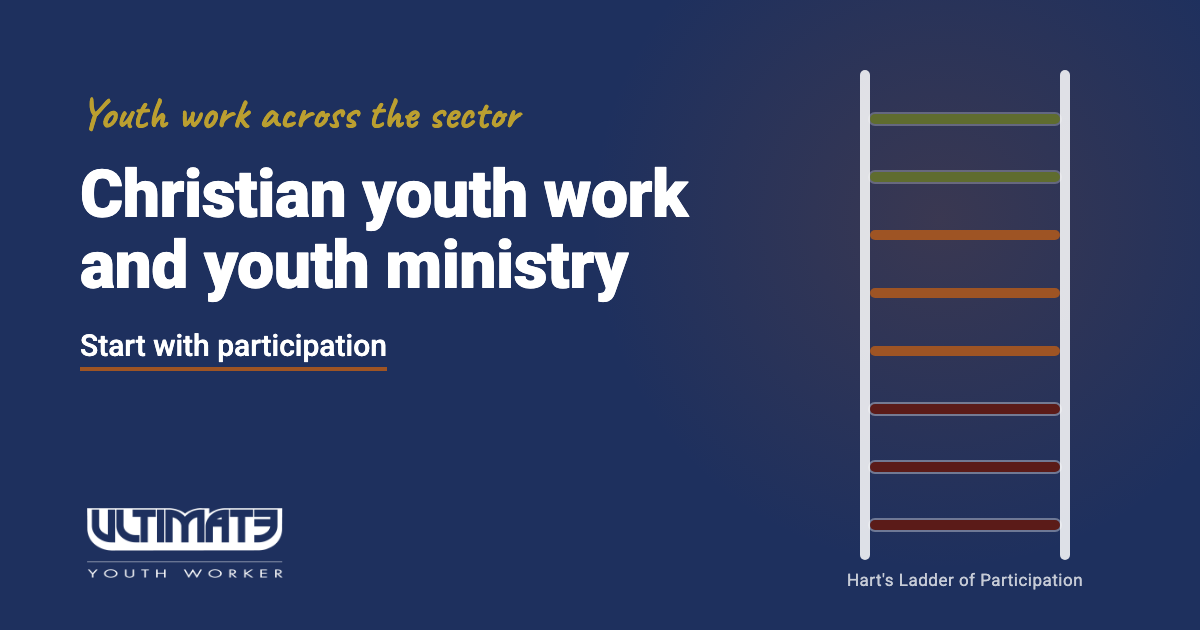
In my view, participation is one of the most revealing measures of youth work, because it shows who really holds power in a program. Hart’s Ladder of Participation (Hart, 1992) describes eight rungs. The bottom three, manipulation, decoration and tokenism, aren’t participation at all: young people are present, and may even be on stage, but they have no real say. The five rungs above describe growing degrees of genuine participation, from young people being assigned a role and told why, through being consulted, to sharing decisions with adults and, at the top, starting projects themselves and inviting adults in. The ladder is useful in youth ministry because it moves the conversation from good intentions to what can actually be seen. It doesn’t ask whether you care about young people. It asks who decided, who was consulted and who could have said no. The ladder is a thinking tool, not a scorecard: not every decision needs to sit at the top rung.
- 8 Young person-initiated, shared decisions with adults
- 7 Young person-initiated and directed
- 6 Adult-initiated, shared decisions with young people
- 5 Consulted and informed
- 4 Assigned but informed
- 3 Tokenism
- 2 Decoration
- 1 Manipulation
Common traps in youth ministry
The traps on the lower rungs are easy to fall into, because from the outside they often look like participation. A youth Sunday where young people read the parts adults have written is decoration. A survey that asks for ideas but never reports back on what happened to them is tokenism. A leadership team where young people run the games but never set the direction sits closer to “assigned but informed” than to shared decision-making. Hart (1992) noted that young people can learn from tokenistic experiences that participation can be a sham. I think that lesson is especially costly in faith settings, where young people are also forming a view of whether their church takes them seriously. Thompson (2017) traces young people’s engagement with, and exclusion from, the church in England across three periods since 1900. I read that as a reminder that these patterns aren’t new. The good news is that moving up a rung rarely needs a new program. It usually needs adults to hand over one real decision.
I saw how hard that handover can feel when I ran a workshop at a Christian conference. Many denominational youth ministry heads were in the room. I talked through Hart’s ladder and argued that it could change most youth ministries from a place to have fun and maybe hear about Jesus into a place where young people grow skills such as leadership, managing finances and program development. The youth ministers all said it was impossible. One asked, “What if the young person stole the money for the ice skating trip?” My answer was that it would be an opportunity for discussion, mentoring and support. A mistake handled well can teach more than a decision that was never handed over. That is what the upper rungs ask of adults: to accept some risk, and to stay alongside young people when things go wrong.
The ladder doesn’t ask whether you care about young people. It asks who decided.
Meeting young people where they are
Participation also means going to where young people already are, rather than waiting for them to come to us. Not all Christian youth work happens in a church hall. Thompson and Ballantyne (2017) drew on the literature and on interviews with seven Christian detached youth workers in the UK, who meet young people on the street and in public spaces. They found that the social and spiritual purposes of the work overlap, that relationships sit at the centre, and that workers keep church agendas at arm’s length. It is a small study, but the point it supports is a useful one: on the street, the young person has more say over the terms, because they choose whether to talk, what to talk about and when the conversation ends. That shifts power in a way a church program rarely does. Even for ministries that never leave the building, the lesson carries over: start with young people’s world, not the program’s.
First steps for your ministry
Building participation is a practice, not a policy, so the best place to start is small and real. The upper rungs of Hart’s (1992) ladder all involve young people sharing in decisions that matter, which is why I’d start by finding one decision adults currently make and handing it over. That could be the theme for next term, the format of a weekly program or how the budget for an event is spent. Tell young people what is genuinely open for them to decide and what isn’t, then report back on what happened to their ideas. For practical tools, the Youth Engagement Resource Platform (YERP) from YACVic, Victoria’s peak body for young people and youth workers, is a good place to start. For detached and street-based work, James Ballantyne, a youth work consultant and trainer, shared a list of detached and outreach youth work resources in a 2020 post on his blog, Learning from the Streets (Ballantyne, 2020). Each small handover builds trust, and trust is what makes the next, bigger step possible.
Participation is also part of keeping young people safe. Churches and faith-based organisations that work with children and young people have child safety obligations. In Victoria, religious bodies, including churches, must meet the Child Safe Standards if they provide services specifically for children, provide facilities specifically for use by children under their supervision, or engage a child as a contractor, employee or volunteer (State Government of Victoria, 2026b). Standard 3 says children and young people are “empowered about their rights, participate in decisions affecting them and are taken seriously” (State Government of Victoria, 2026a). If you’re outside Victoria, check what your state or territory requires. Either way, the participation questions above are not only good ministry practice. They connect directly to what child safe standards ask of you.
How we can help
Child safety, youth engagement and supervision
Participation and child safety overlap, and that is where we can help.
Some youth ministers work alone, or report to a senior minister who isn’t trained in youth work. Holding faith, church expectations and young people’s rights all at once is hard to do without somewhere to reflect. External supervision can give you that space. You can start with our free supervision agreement template.
Further reading for youth ministers
Author to follow
Anything by Naomi Thompson
Naomi is Reader in Youth and Community Work and Associate Head of School at Goldsmiths, University of London. Start with Young People and Church Since 1900: Engagement and Exclusion (Thompson, 2017), then her research with James Ballantyne on Christian detached youth work (Thompson & Ballantyne, 2017). Her 2012 article on the purposes of Christian youth work was published under her earlier name, Naomi Stanton (Stanton, 2012).
Forthcoming book
Faith-Based Youth Work: Critical Perspectives on Purpose, Practice, and Pedagogy
By Mark McFeeters (2026), Lecturer in Community Youth Work at Ulster University. Drawing on research with young people and youth workers involved in Christian faith-based youth work in Northern Ireland, it asks what makes that work distinctive.
References
Ballantyne, J. (2020, September 18). Detached and outreach youth work resources. Learning from the Streets. https://jamesballantyneyouthworker.co.uk/detached-and-outreach-youth-work-resources/
Clyne, A. (2015). Uncovering youth ministry’s professional narrative. Youth & Policy, 115, 19-42. https://www.youthandpolicy.org/wp-content/uploads/2017/06/clynne-115.pdf
Cooper, T., & White, R. (1994). Models of youth work intervention. Youth Studies Australia, 13(4), 30-35.
Hart, R. A. (1992). Children’s participation: From tokenism to citizenship (Innocenti Essays No. 4). UNICEF International Child Development Centre.
McFeeters, M. (2026). Faith-based youth work: Critical perspectives on purpose, practice, and pedagogy. Policy Press.
Stanton, N. (2012). Christian youth work: Teaching faith, filling churches or response to social need? Journal of Beliefs & Values, 33(3), 385-403. https://doi.org/10.1080/13617672.2012.732818
State Government of Victoria. (2026a). Complying with the Child Safe Standards. https://www.vic.gov.au/complying-child-safe-standards
State Government of Victoria. (2026b). Who the Child Safe Standards apply to. https://www.vic.gov.au/who-child-safe-standards-apply
Thompson, N. (2017). Young people and church since 1900: Engagement and exclusion. Routledge.
Thompson, N., & Ballantyne, J. (2017). “Being church”: The social and spiritual purposes and impacts of Christian detached youth work. Journal of Youth and Theology, 16(2), 89-116. https://doi.org/10.1163/24055093-01602002
